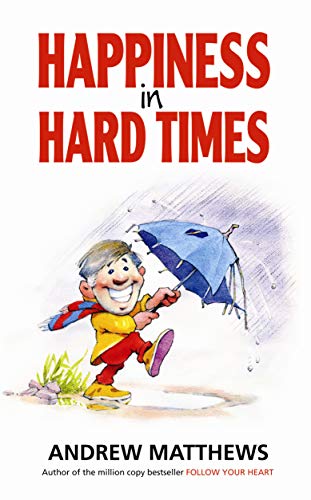
Happiness in Hard Times by Andrew Matthews
Contents Link to heading
- Acceptance (Pages 2-5) -- 7 notes, 2 exercises
- One Day at a Time (Pages 6-10) -- 6 notes, 4 exercises
- Learning from Pain (Pages 11-19) -- 9 notes, 0 exercises
- Mindset & Rules (Pages 22-35) -- 12 notes, 0 exercises
- Disasters as Opportunities (Pages 36-52) -- 16 notes, 5 exercises
- Self-Image (Pages 60-95) -- 22 notes, 1 exercises
- Forgiveness & Letting Go (Pages 97-114) -- 13 notes, 0 exercises
- Money & Detachment (Pages 117-137) -- 12 notes, 0 exercises
- Taking Action & Persistence (Pages 139-149) -- 6 notes, 1 exercises
- Visualization & Belief (Pages 152-169) -- 10 notes, 0 exercises
- Gratitude & Abundance (Pages 173-214) -- 31 notes, 1 exercises
Acceptance Link to heading
Pages 2-5
Notes Link to heading
You accept where you are.
To turn things around you first make peace with your situation. Forget about blame, forget about guilt, forget the "what ifs." Progress depends on acceptance. Acceptance doesn't mean, "I want to stay here." Acceptance means: "This is where I am- and now I move on to what I want."
Acceptance isn't giving up. Acceptance is recognition that, "This is a part of my journey." Very often it means, "Right now I have no idea why this had to be a part of my journey but I embrace it anyway."
Acceptance is power.
The motivation behind everything you do- and the motivation behind everything everybody does- is to feel better.
We all chase happiness- it's automatic- but some people worry that it is selfish. So they feel guilty- and that makes them unhappy!
It's not selfish to seek happiness. IT IS SELFISH TO BE MISERABLE! Happy people are more thoughtful and more considerate. It's unhappy people who are preoccupied with themselves. Happy people make better friends, better lovers and better employees.
Exercises Link to heading
Exercise 1: The Acceptance Inventory Link to heading
Story: A man lost his job at 45 and spent months blaming the economy, his boss, and his colleagues. His young daughter asked him one evening why he was always angry. That night, he wrote on a scrap of paper: "This is where I am -- and now I move on." He pinned it above his desk. Within a week, he had updated his resume and scheduled his first networking call. Why This Works: Acceptance is the foundation of all change. When you stop fighting reality, the energy you wasted on resistance becomes available for constructive action. The simple act of naming where you are breaks the paralysis of denial.
How to execute:
Write down one situation you are currently fighting -- a job loss, a health issue, a relationship problem. Say the words aloud: "This is where I am -- and now I move on to what I want." Do this every morning for 7 days. Variation 1: Replace the second half with a specific goal: "This is where I am -- and now I apply for three jobs this week." Variation 2: If the situation is deeply painful, start smaller: "This is where I am -- and now I make my bed." Variation 3: Share your acceptance statement with one trusted friend and ask them to check in after a week. Watch Out For: Do not confuse acceptance with approval. You are not saying the situation is good. You are saying it is real. If you feel fake saying the words, write them anyway -- the feeling follows the action, not the other way around.
Exercise 2: Stop Apologizing for Happiness Link to heading
Story: A mother of three felt guilty every time she took an hour for herself. Her husband finally told her: "Our kids need a happy mother, not a martyr." She started scheduling 30 minutes of alone time daily. Within two weeks, her patience with the children doubled and she stopped snapping at her partner. She realized her guilt had been a habit, not a virtue. Why This Works: Many people believe that suffering equals virtue, especially when caring for others. But the book directly states: "It is selfish to be miserable." Happy people are more generous, patient, and effective. Guilt about happiness is a learned response that can be unlearned.
How to execute:
For the next 3 days, every time guilt about doing something for yourself arises, pause and say: "It is selfish to be miserable. Happy me is better for everyone." Then proceed with your self-care without further justification. Variation 1: Keep a tally of guilt moments -- just noticing them reduces their power. Variation 2: Ask someone close to you to point out when you are apologizing for being happy. Variation 3: Schedule one non-negotiable weekly activity that is purely for your enjoyment. Watch Out For: The people around you may resist your new boundaries at first because your unhappiness was convenient for them. Hold steady. Your happiness is not a betrayal of anyone.
Exercise 3: The 24-Hour Challenge Link to heading
Story: A startup founder was drowning in worry about runway, hiring, and product-market fit. He wrote "All I can do is give my best effort until bedtime. Let tomorrow take care of itself" on a sticky note and put it on his monitor. Every time his mind jumped to next month's problems, he tapped the note and returned to today's single task. His anxiety dropped noticeably within three days. Why This Works: The book teaches that humans are designed to live 24 hours at a time. Carrying tomorrow's worries today is like packing food for a lifetime-long march. This exercise trains the mind to narrow its focus to the only timeframe you can actually influence.
How to execute:
Write "All I can do is give my best effort until bedtime" on a sticky note. Place it somewhere you will see it constantly -- your phone lock screen, bathroom mirror, or monitor. For 7 days, whenever you catch yourself worrying about the future, read the note aloud and identify one thing you can do before bed. Variation 1: Set a phone alarm that goes off three times daily with the label "Today only." Variation 2: End each evening by writing "I gave my best effort today because..." and list three specific actions. Variation 3: If a future worry feels urgent, schedule a 15-minute worry block for tomorrow and refuse to think about it until then. Watch Out For: Your mind will resist narrowing its focus. Planning for the future is not the same as worrying about it. Keep strategic plans in a calendar and refuse to let them become emotional burdens.
Exercise 4: Define "Enough" for Today Link to heading
Story: A perfectionist executive measured himself against a constantly moving finish line. No matter how much he accomplished, he felt behind. A therapist told him to write three things he did well every night before bed. At first he struggled to find even one. After a month, he noticed he no longer dreaded mornings. The habit had rewired his brain to register progress instead of gaps. Why This Works: Perfectionism is rooted in a scarcity mindset -- there is never enough, and you are never enough. Defining "enough" for today creates a finish line you can actually cross. Small wins build momentum and self-trust.
How to execute:
Every night before bed, write three things you did well today. They do not need to be impressive: "I got out of bed," "I ate a vegetable," "I was kind to the cashier." Do this for 21 days. Variation 1: If you cannot think of three, start with one. Variation 2: Add a column for "What went better than expected." Variation 3: Share your three items with a partner or friend each evening for accountability. Watch Out For: The voice that says "That doesn't count" is the perfectionism you are trying to overcome. Everything counts. The size of the win does not matter -- only the practice of noticing it.
Exercise 5: The Movie Question Link to heading
Story: Andrew Matthews asks: "If your life were a movie, how would this chapter look?" This question creates instant distance from your problems. One reader described her divorce chapter as "The one where she realizes she married the wrong person and walks out with her dignity." That simple framing helped her stop seeing herself as a victim. Why This Works: Detached observation is a core psychological skill. By viewing your life as a story, you shift from emotional reactivity to perspective. You become the narrator of your life rather than the character being acted upon.
How to execute:
Take 5 minutes to write one sentence answering: "If my life were a movie, what is the title of this chapter?" Then write two sentences about how this chapter serves the larger story. Variation 1: Re-title a past difficult chapter from the perspective of what you know now. Variation 2: Describe your current chapter as if you are the wise narrator looking back five years from now. Variation 3: Share your chapter title with a friend and ask what title they would give it. Watch Out For: Avoid making your chapter a tragedy unless you genuinely need to honor grief first. The goal is not toxic positivity but perspective. If you are in acute pain, simply name it: "The Hard Part."
One Day at a Time Link to heading
Pages 6-10
Notes Link to heading
If you go rock climbing and you get stuck on a ledge, you suddenly focus on the present moment! When your life is in danger, you forget about the future. All your effort goes into your next step. Then your next step. Inch by inch. Eventually you claw your way out.
If you were embarking on a day's march, wouldn't it be foolish to try to carry enough food and water for a lifetime? Is it not strange, then, that many people carry around all their worries for the next 25 years and wonder why life is so difficult? We were designed to live 24 hours at a time. No more.
All you can do is give your best effort until bedtime. Let tomorrow take care of itself.
You never know how you will react to tragedy. It's like when you imagine a tiger jumping through your window. You say, "If a tiger leaped into my living room, I would do this!" But when the real tiger arrives, you do something totally different.
Life is like a movie. It's not the length but the quality that matters.
There is no secret to happiness. You just choose it.
Exercises Link to heading
Exercise 6: The Turning Point Audit Link to heading
Story: A businessman who lost everything in a recession sat down and asked: "What did losing everything force me to become?" His answers surprised him: humble, resilient, present with his kids, and finally willing to pursue work he actually cared about. He realized the loss was also a gift he would not have chosen but would not trade. Why This Works: The book argues that every crisis contains a turning point. When you ask "What did this force me to become?" instead of "Why did this happen to me?" you transform victimhood into agency. The question itself reshapes your relationship with pain.
How to execute:
List your three biggest setbacks. For each one, complete the sentence: "This forced me to become..." Write at least two answers per setback. If you cannot find anything positive, start with neutral observations: "It forced me to move to a new city" or "It forced me to change careers." Variation 1: Interview someone who went through a similar setback and ask what they gained. Variation 2: Write a letter of gratitude to the setback itself -- not to send, but to see it differently. Variation 3: Create a timeline of each setback and the opportunities that followed within 2-3 years. Watch Out For: Do not force gratitude prematurely. If you are still in the middle of the pain, it is okay to say "This forced me to survive, and that was enough." The audit works best with some distance from the event.
Exercise 7: Replace "Why Me?" with "What Now?" Link to heading
Story: A project manager watched a product launch fail spectacularly -- the demo crashed, the client walked out. Her first instinct was "Why does this always happen to me?" But she had been practicing this exercise. She took a breath and asked: "What can I do, just today?" She called the client to apologize and offered a free prototype. The client renewed six months later. Why This Works: "Why me?" is a loop question -- it has no productive answer and keeps you stuck in the problem. "What now?" is an exit question. It redirects your brain from rumination to problem-solving, which is the fastest path out of helplessness.
How to execute:
For one full week, whenever something goes wrong, pause and say aloud: "What can I do, just today?" If the answer is "Nothing today," accept that and set a specific time tomorrow to act. Variation 1: Write "WWND?" (What Now, Not Why) on your hand or phone. Variation 2: After answering "What now?" for yourself, ask a trusted friend or colleague for their perspective. Variation 3: Keep a log of every "What now?" moment and the action you took -- review it weekly to see the pattern of your resilience. Watch Out For: Some situations genuinely require grief or processing before action. Allow yourself 24 hours to feel before forcing the "What now?" shift. The exercise is about not getting stuck, not about bypassing legitimate emotions.
Exercise 8: The Weakness Check Link to heading
Story: An employee watched a colleague take credit for her work for nearly two years. She told herself she was being gracious but was actually terrified of confrontation. When she finally documented everything and scheduled a meeting with her director, the colleague was reassigned within a month. She realized her grace had been passivity dressed up as virtue. Why This Works: The book emphasizes that avoiding confrontation is not kindness -- it is self-betrayal. Passivity masquerading as virtue is one of the most common ways people stay stuck. Naming your weakness is the first step to reclaiming your power.
How to execute:
Ask yourself honestly: "Where am I being passive?" Write down one situation where you are tolerating something that bothers you. Take one step today -- send an email, make a request, state a boundary. Variation 1: Ask a trusted friend: "Where do you see me settling for less than I deserve?" Variation 2: For chronic passivity, set a weekly courage hour where you address one thing you have been avoiding. Variation 3: Start with low-stakes situations -- return an item, question a bill, ask for a better seat -- to build the muscle. Watch Out For: The difference between patience and passivity is whether you have a plan. Patience is strategic waiting. Passivity is hoping things will change without your involvement. If you have no plan, you are not being patient.
Exercise 9: Small Steps Journal Link to heading
Story: A writer had been blocked for two years. The thought of finishing a novel was paralyzing. He committed to writing one sentence per day. The first day he wrote seven words. The second day, twelve. Within a month, he was writing 500 words daily. The novel took eighteen months, but it was finished. Why This Works: Overwhelm comes from looking at the whole mountain. The book teaches that you only need to take the next step. One sentence is not intimidating. But the act of showing up daily creates momentum that carries you far beyond your expectations.
How to execute:
Pick one goal you have been avoiding. Define the smallest possible version of progress -- one sentence, one push-up, one dollar saved, one minute of practice. Do it every evening. If you miss a day, do not double up -- just do your single unit again. Variation 1: Track your streak on a calendar and do not break it. Variation 2: Increase by 10% each week after you have established a 7-day streak. Variation 3: Announce your commitment publicly so the cost of quitting becomes higher than the cost of continuing. Watch Out For: Do not increase the minimum too quickly. The magic is in the consistency, not the volume. If you raise the bar too soon, you will trigger the same resistance that stopped you before.
Learning from Pain Link to heading
Pages 11-19
Notes Link to heading
We learn our biggest lessons when things get rough.
Success we celebrate- but we don't learn too much. Failure hurts- and that's when we get educated. In retrospect, we usually notice that "disasters" were turning points.
Effective people ask "WHAT?" questions, "WHAT do I learn from this? WHAT am I going to do about it?" When the situation is really desperate, they ask, "WHAT can I do, just today, to make things better?"
We are creatures of habit. We keep doing what we're doing until we're forced to change.
The happiest people don't bother about whether life is fair. They just concentrate on what they have.
It's always easier to be philosophical about other people's pain!
Nature's law is that the weak get bullied.
you can't love other people until you can love yourself.
progress happens in small steps. Look for good things, focus on the present and do what you can do today. As you change, so your life changes.
Exercises Link to heading
Exercise 10: The Rules Audit Link to heading
Story: A husband was perpetually disappointed in his wife. He sat down and filled two pages with all the rules she was breaking -- how she loaded the dishwasher, how she greeted him, how she spent weekends. Reading it back, he realized these were not universal laws. They were his preferences dressed up as expectations. He crossed the whole list out and instead wrote one sentence: "I will ask for what I need directly." Why This Works: The book shows that most of our suffering comes from unspoken rules we expect others to follow. Writing them down exposes how arbitrary they are. Dropping the rules is not about lowering standards -- it is about replacing silent resentment with clear communication.
How to execute:
Take 15 minutes and write every "should" you hold about a specific person or situation. Be brutally honest. Then read each one and ask: "Is this a universal law, or my preference?" Cross out every preference-based rule. Variation 1: Repeat for yourself -- what shoulds do you hold about how you should be? Variation 2: For one week, catch yourself every time you think "should" and replace it with "I prefer" or "I wish." Variation 3: Make your remaining non-negotiable rules explicit and communicate them clearly to the relevant people. Watch Out For: You will discover that most of your rules are about controlling how other people make you feel. The real work is not getting them to follow your rules but learning to feel okay regardless.
Exercise 11: The Thought Swap Link to heading
Story: A woman spent her 45-minute commute mentally replaying every complaint she had -- her boss, her traffic, her to-do list. She decided that every time she noticed a complaint, she would ask: "What is good about this?" At first it felt forced. By the end of the first week, she noticed her shoulders dropping. By the third week, the complaints had mostly stopped. Why This Works: The brain is a pattern-matching machine. What you look for, you find. By deliberately searching for the positive, you create a new neural pathway. Over time, the default mode shifts from scanning for threats to scanning for opportunities.
How to execute:
For 7 days, every time you catch a negative thought, pause and ask: "What is good about this?" Keep a tally of swaps in your phone notes. The goal is not zero negative thoughts but increasing the ratio of swaps. Variation 1: Set three random alarms per day labeled "SWAP" -- when they ring, find something good in your immediate environment. Variation 2: At the end of each day, write three positive things you noticed that you would have missed before. Variation 3: When someone complains to you, silently find one good thing in their situation -- do not say it aloud, just notice it. Watch Out For: This is not about suppressing negative emotions. Legitimate grief, anger, and frustration deserve space. This exercise targets the automatic, repetitive complaining that serves no purpose.
Exercise 12: The Mirror Check Link to heading
Story: A salesperson started tracking his morning mood against his daily outcomes. He noticed a pattern: anxious mornings predicted lost deals; calm mornings predicted closed deals. His internal weather was creating his external reality. By paying attention to his state, he began to manage it instead of being managed by it. Why This Works: The book teaches that your emotional state determines your results more than your strategy does. Most people do not connect how they feel with what they produce. Tracking this connection gives you leverage to shift your state before taking action.
How to execute:
For 7 days, write down your dominant morning feeling (anxious, calm, angry, excited) on a scale of 1-10. At night, note what happened that day -- key interactions, decisions, outcomes. At the end of the week, look for correlations. Variation 1: If you notice a pattern, experiment with a pre-meeting ritual like breathing or music. Variation 2: Share your findings with one colleague and ask if they see the pattern too. Variation 3: Extend to 21 days and add a note about your sleep and exercise from the previous day. Watch Out For: Correlation is not causation. Your morning mood might be a signal, not a cause. Do not use this to blame yourself for bad outcomes. Use it as data for what needs your attention.
Exercise 13: Happiness is a Decision Link to heading
Story: A man going through a divorce decided to say "I choose to be happy today" every morning. He did not believe it. The first nine days felt mechanical and hollow. On day ten, something shifted -- he noticed he was smiling without forcing it. The words had reprogrammed his default. Why This Works: The book's core insight is that happiness is not a response to circumstances but a decision you make repeatedly. Conscious repetition reprograms the subconscious, where your automatic responses live. The feeling follows the choice, often with a delay.
How to execute:
Every morning, immediately after waking, say aloud: "I choose to be happy today." Say it even if you do not believe it, even if your life is a mess. Commit to 7 days. Variation 1: Add a specific reason: "I choose to be happy today because I get to..." Variation 2: Say it in the mirror while looking yourself in the eyes. Variation 3: Pair it with a physical gesture -- hand on heart or fist pump -- to anchor it. Watch Out For: This will feel fake for the first several days. That is normal and expected. Do not let the feeling of fakeness stop you. The mechanical repetition is the mechanism, not a bug.
Mindset & Rules Link to heading
Pages 22-35
Notes Link to heading
the best place to make a new start is where you are!
It's not about your age, it's about your attitude.
If you are feeling down or depressed, only you can change your thoughts. Step by step, you pull yourself out of the hole. As you begin to look on the bright side, you attract happy friends and colleagues.
In the real world, other people don't change our lives. We do it ourselves.
our stress is caused by rules in our own head. As we relax some of the rules, or drop them altogether, we become happier.
There are alternatives to getting angry. It is possible to be fascinated or amused. The fewer rules you have about how life ought to be, and how other people ought to behave, the easier it is to be happy.
When our self- worth is dependent on the stuff we own, we play a losing game.
You will be happy with stuff only if you can be happy without stuff.
The happiest people aren't waiting for anything to happen.
One negative thought attracts another. One positive thought attracts another. Before the plague starts, ask yourself, "What's good about this?"
It's not WHAT HAPPENS TO YOU that matters most. It's how YOU FEEL ABOUT what happens to you.
When you fi ght life, life always wins!
Exercises Link to heading
Exercise 14: Reframe a "Disaster" Link to heading
Story: An entrepreneur lost 60% of his revenue when a major client left. He was devastated for a week. Then he forced himself to write down every opportunity hidden in the loss: diversify his client base, build a product, reduce dependency, focus on higher-margin work, spend more time with family. Two years later, his client base was 10x larger and more stable than before. Why This Works: Every disaster contains opportunities, but they are invisible while you are in the emotional storm. Forcing yourself to find them deliberately retrains your brain to see crisis as transformation. The book calls this looking for the gift.
How to execute:
Pick one current problem. Write at the top: "If this is an opportunity, what could it be?" List five possibilities without judgment. Some will be absurd. Some will be real. The act of generating possibilities shifts your brain from threat-detection to creation mode. Variation 1: Ask three people who are not invested in your problem to list opportunities they see. Variation 2: Look back at a past disaster and list what it made possible that would not have happened otherwise. Variation 3: For each opportunity, assign one small action step you could take this week. Watch Out For: Do not use this exercise to bypass grief or legitimate pain. Let yourself be disappointed first. The reframe works after the emotions have been felt, not instead of them.
Exercise 15: Drop the "Should" Link to heading
Story: A father was furious that his son had dropped out of college to pursue music. Every conversation ended in a fight. A friend told him: "Replace 'should' with 'is.' He is who he is." The father started practicing this. Within a week, the fighting stopped. Within a month, his son invited him to a gig. The relationship transformed. Why This Works: "Should" is the language of resistance. It asserts that reality is wrong and needs to be different. Dropping "should" is not about lowering standards -- it is about stopping the war with reality. The book calls this one of the fastest routes to peace.
How to execute:
For one full day, eliminate the word "should" from your internal and external vocabulary. Every time you catch yourself thinking it, rephrase as observation: "He is..." or "This is..." Variation 1: Extend to 7 days and add "must," "ought to," and "have to" to the banned list. Variation 2: Journal at the end of each should-free day about what felt different. Variation 3: Notice "should" in others' speech and silently observe how it correlates with their stress. Watch Out For: This will be harder than you expect. "Should" is deeply embedded. Do not judge yourself for slipping -- just restart. The goal is not perfection but increasing awareness of how much of your suffering is self-imposed.
Exercise 16: Pain as Messenger Link to heading
Story: A designer felt a spike of jealousy when a colleague was praised. Instead of suppressing it, she sat with the feeling for two minutes and asked: "What are you telling me?" The answer surprised her: "You want recognition too. You have not asked for it. You have been waiting to be noticed." She scheduled a meeting with her boss to share her recent work. The jealousy disappeared once she acted on its message. Why This Works: The book teaches that negative emotions are messengers, not enemies. Jealousy points to what you want. Anger points to a boundary violation. Anxiety points to preparation needed. When you listen to the message instead of fighting the feeling, the emotion dissolves naturally.
How to execute:
The next time you feel a strong negative emotion, stop and set a timer for 2 minutes. Sit with the feeling physically -- notice where it lives in your body. Then ask: "What are you telling me?" Write the first answer that comes, even if it seems silly. Variation 1: Create a pain dictionary -- after each emotion, write the message and what action it suggests. Variation 2: For chronic emotions, set a weekly check-in: "What has this recurring feeling been trying to tell me?" Variation 3: Share the message with someone you trust and ask if it resonates. Watch Out For: Not every negative feeling has a deep message. Sometimes you are just tired, hungry, or hormonal. Rule those out first before mining for meaning.
Exercise 17: Self-Image Audit Link to heading
Story: A talented designer was charging half the market rate and constantly struggling to find clients. During this exercise, she uncovered a belief from age 16: "I don't deserve to be well-paid" -- something her father had said during an argument. She rewrote the belief to: "I deserve to be compensated fairly for value delivered." She raised her rates. Her clients paid without question. Her income doubled in six months. Why This Works: Your self-image determines your ceiling. If you believe you are undeserving, you will unconsciously sabotage success to stay aligned with your identity. Exposing the belief and consciously rewriting it is the only way to break the pattern.
How to execute:
Write down what you believe you deserve in each area: love, money, respect, health, happiness. Be honest -- no aspirational answers. Then trace each belief back to its origin. When did you first decide this? Finally, write a replacement belief that supports what you want. Variation 1: Ask a trusted friend: "What do you think I believe about myself?" Their answer may reveal blind spots. Variation 2: For one week, notice when your actions contradict your stated goals -- that gap reveals a hidden belief. Variation 3: Test your new belief with a small experiment: ask for what the old belief said you did not deserve. Watch Out For: Old beliefs will fight back. When you first raise your rate or ask for more, your identity will scream that you are being arrogant. That discomfort is the sign that you are growing, not that you are wrong.
Disasters as Opportunities Link to heading
Pages 36-52
Notes Link to heading
Once we change our thoughts about "a bad situation," we can take advantage of it. Life's great opportunities mostly arrive disguised as misfortune and disaster.
Every "disaster" in your life is not so much a disaster, as a situation waiting for you to change your mind about it.
Life is beautiful. Life is worth fighting for. It's not what happens to you, it's what you do with it.
Here's a recipe for permanent misery... a) Decide how you think the world SHOULD be. b) Make rules for how everyone SHOULD behave. Then, when the world doesn't obey your rules, get angry! That's what miserable people do!
The measure of our wisdom is much more about whether we embrace changing circumstances and accept people who are different from ourselves.
Happy people welcome change. They're the guys who say, "Why would I even want my next five years to be like my last five?"
Physical pain is a marvellous alarm system that prevents further damage. It tells us, "You'd better change what you're doing!" Emotional pain gives us a similar message, i.e. "You'd better change how you're thinking!" It's normal to get angry or jealous or a bit resentful- temporarily. But if those feelings become permanent the message may be: Don't expect to control other people. Don't expect other people to behave like you. Don't depend on other people to make you happy!
we keep thinking the same thoughts, we keep feeling the same pain. And then we say, "But I'm right!" Unfortunately being "right" doesn't help!
The good thing about pain and suffering is that they erode the ego. When we can no longer stand the pain, we shift from "I'm right- there is no other way to see this!" to "I can't take it anymore- maybe I could have a different point of view!"
With both physical and emotional pain, when we keep doing the same thing, it keeps hurting!
when you argue with reality, reality always wins. It doesn't matter how resentful you get or how many times you say, "It shouldn't have happened!" What is, is.
Facts are what is. The first step to happiness is accepting what is.
A lot of perfectly healthy people are unhappy. A lot of brain- injured people are happier than most. Families faced with huge challenges are often the happiest and the most loving.
Next time you want to tell yourself, "I can't be happy because..." ask yourself, "Do I know that this is absolutely true?"
The idea that you might actually choose happiness seemed strangely ridiculous. I thought that happiness was like influenza- sometimes you get it, sometimes you don't. Could you choose to be happy?
When you really, really want to be happy, here is what will happen: you will think about things that make you feel good you will talk about things that make you feel good.
Exercises Link to heading
Exercise 18: Kill Self-Criticism (7 Days) Link to heading
Story: An executive was known for being hard on herself. A coach challenged her: "No self-criticism for 7 days. Not one negative thing about yourself." She thought it would destroy her performance. Instead, her clarity improved, her team reported she was more approachable, and her happiness rose measurably. Her performance did not drop. Why This Works: The book states clearly: "When you constantly criticise yourself, you sabotage your life." Self-criticism feels like rigor but is actually fear. It does not drive improvement -- it drives shrinkage. Removing it reveals that you can improve without punishment.
How to execute:
For 7 days, you are not allowed to say or think anything negative about yourself. When you catch a critical thought, immediately replace it with an appreciation: "I caught that -- good. I am learning." If you slip, restart the 7-day clock. Variation 1: Wear a rubber band on your wrist and snap it when you self-criticize. Variation 2: Ask someone you live with to call out when they hear you self-criticize. Variation 3: At the end of each day, write one thing you appreciated about yourself. Watch Out For: Your inner critic will get louder before it quiets down. It will tell you that stopping criticism means lowering standards. This is a lie. Standards are maintained by clear goals and feedback, not by self-attack.
Exercise 19: Affirmation Practice (21 Days) Link to heading
Story: A quiet employee chose the affirmation: "I am intelligent, capable, and my voice matters." She said it in the mirror three times daily. It felt absurd for the first two weeks. In week three, she volunteered an idea in a meeting. It was well received. By week four, she was leading a project. The words had become her internal script. Why This Works: The book calls affirmations "one of the surest ways to program your subconscious." The subconscious does not distinguish between what is real and what is repeatedly imagined. By feeding it a new script, you overwrite the old programming of doubt and limitation.
How to execute:
Choose one affirmation that directly counters your most common negative belief. Say it three times while looking in the mirror, morning and night, for 21 days. Say it with feeling -- emotion is the catalyst that makes words sink in. Variation 1: Record yourself saying it and listen during your commute. Variation 2: Write it on sticky notes placed where you will see them throughout the day. Variation 3: Add a physical gesture -- hand on heart, standing tall -- to anchor the affirmation in your body. Watch Out For: The first 7-10 days will feel ridiculous. You may laugh or cringe. This is the resistance of the old program. Continue anyway. The mechanical repetition is the mechanism, not a sign that it is not working.
Exercise 20: Appreciate Others Link to heading
Story: A cynical developer thought most of his colleagues were incompetent. He committed to appreciating one person daily -- a genuine quality, said directly to them. It was uncomfortable at first. By the end of the first month, he noticed he was less cynical and people were more open with him. The act of looking for good in others had changed his internal state. Why This Works: The book states: "When you look for good things in other people, you find those things in yourself." Appreciation is not just for the receiver -- it transforms the giver. It shifts your focus from lack and judgment to abundance and connection.
How to execute:
Each day, identify one quality you genuinely appreciate in someone and tell them directly. Be specific: "I appreciate how you handled that difficult customer call -- you stayed calm and clear." Do this for 21 days. Variation 1: Write an appreciation note and leave it anonymously. Variation 2: At dinner, have each family member share one appreciation for another person at the table. Variation 3: When you feel negative about someone, challenge yourself to find one thing to appreciate about them. Watch Out For: This will feel forced and awkward initially, especially if you are not used to expressing appreciation. That is fine. The discomfort is the habit of criticism breaking down.
Exercise 21: Compassion for Self and Others Link to heading
Story: A medical resident was constantly angry at patients who did not follow advice. A supervisor asked her: "What would you say to your best friend if they were in this patient's position?" She realized she would be kind and understanding -- not angry. She started treating patients with the same compassion she would a friend. Her anger softened, her patients opened up, and her job satisfaction transformed. Why This Works: The book teaches that self-compassion and compassion for others are the same muscle. When you extend understanding to yourself, it naturally flows outward. Anger and judgment are the opposite of compassion -- they keep you separate and superior, but also isolated.
How to execute:
When you feel judgment toward someone, ask: "What would I say to my best friend in their position?" Then say that to the person or about them silently. Variation 1: When you are harsh with yourself, ask the same question and apply the answer to yourself. Variation 2: Keep a compassion journal -- each day, note one way you were kind to yourself and one way you extended understanding to another. Variation 3: Before entering a potentially difficult interaction, set the intention: "I will lead with compassion." Watch Out For: Compassion is not the same as letting people off the hook. You can hold someone accountable and still be compassionate. The two are not opposed. True accountability is compassionate because it supports growth.
Self-Image Link to heading
Pages 60-95
Notes Link to heading
The world is a mirror- what you feel inside, you get on the outside- which is why YOU CAN'T FIX LIFE BY WORKING ON THE OUTSIDE.
Uplifting thoughts attract uplifting experiences. Angry, victim- type thoughts attract low energy experiences.
We attract what we feel. While you feel unloved you cannot attract love. While you feel lonely you cannot attract friends. While you feel broke you cannot attract prosperity.
When life is tough, we are part of the problem. You say, "But when my life gets better I will feel better." There's the catch. YOU NEED TO FEEL BETTER FIRST- about yourself, about your work, about your bank balance- then things get better.
Life can be hard. Never quit! If you want something bad enough, no matter what the odds, you can do it.
Our self- image is the blueprint that determines exactly how we will behave, who we will mix with, what we will try and what we will avoid. Every thought and every action stems from the way we see ourselves.
What you achieve and what you receive are entirely dependent on your thinking. All of your thoughts are shaped by your self- image. If at the deepest level you believe you don't deserve something, then you will either a) never get it or b) get it and lose it.
When you believe, "Life is unfair and I'm always broke," you find creative ways to squander suitcases full of cash in a weekend. It's not a financial management problem, it is a self- image problem.
How you feel about you is in your hands.
You are not your story and nobody cares anyway. You don't belong in a category or a box. You are a human being having a series of experiences. When you quit dragging a story around, you never have to look the part. You can relax.
It doesn't matter how much you know. It doesn't matter how many books you have read or how many positive quotes you have pinned on your wall. If you don't appreciate yourself you will not allow the things you want into your life. You have to feel you deserve it.
SELF- CRITICISM ISN'T HUMILITY- IT IS STUPIDITY.
We crave compliments but as quickly as we receive them, we dismiss them.
What you think of you is more important than what anyone else thinks of you! Many people don't even believe they have the right to choose what is best for them. But if you don't have the right to choose what is right for you, who has?
It is no one else's responsibility to love you. It is your responsibility to love yourself.
noticing good things outside of yourself makes you feel better inside.
When you look for good things in other people, you find those things in yourself. THE FAST TRACK TO SELF- APPRECIATION IS IN APPRECIATING OTHERS.
Positive affirmations are one of the surest ways to program your subconscious for the life you want and deserve.
Stop seeing yourself as guilty. Your behaviour is not connected to your self- worth. If you do something stupid, it doesn't make you a bad person. You simply made a mistake. Loving yourself means forgiving yourself.
People treat you as you treat you, the world treats you as you treat you.
When we are preoccupied by our own faults, we look for the same faults in other people in the hope it will make us feel better. And we find them, but we don't feel better.
When we forgive ourselves, we stop criticising other people.
Exercises Link to heading
Exercise 22: The Gratitude List Link to heading
Story: A woman struggling with chronic pain kept a gratitude list for 30 days. The first week was forced: "Grateful for running water. Grateful for toast." By week three, she noticed her baseline mood had lifted. The pain was still there, but it no longer defined her day. Her doctor noticed her vitals had improved. Why This Works: The book teaches that gratitude is not denial of pain but a separate track you can run alongside it. The brain can hold both: this hurts, and this is good. Gratitude trains the brain to scan for positives, creating a counterweight to the negativity bias that evolution hardwired into us.
How to execute:
Each night, write 5 things you are grateful for. They can be small: "A good cup of coffee," "A stranger smiled at me," "My legs work." Do not repeat items. Do this for 21 days. If you cannot find 5, write 3. Variation 1: Send one gratitude text per day to someone who made your life better. Variation 2: Keep a physical jar and add a written gratitude note each day -- read them all on New Year's Eve. Variation 3: Before eating any meal, pause for 3 seconds and silently appreciate the food, the people who grew it, and your ability to eat. Watch Out For: Toxic gratitude -- using gratitude to bypass legitimate negative emotions -- is not the goal. You can be grateful AND sad, grateful AND angry. The exercise works alongside your feelings, not instead of them.
Exercise 23: The Mini Project Link to heading
Story: A man who felt professionally stuck started building birdhouses in his garage after work. It had nothing to do with his job as an accountant. But the act of creating something concrete with his hands restored a sense of competence and completion he had lost. Six months later, he started a small woodworking business on the side. Why This Works: The book encourages taking on small projects as a cure for stagnation. A mini project creates a contained arena for success, creativity, and completion. It reminds you that you are capable of making things happen, restoring confidence that bleeds into other areas of life.
How to execute:
Choose a small project you can complete in 2-4 weeks. It should be something new that requires learning. It does not need to be impressive -- learn to bake sourdough, build a shelf, plant a garden, write a short story. Set a deadline and tell someone about it. Variation 1: Make it a weekly project -- one small thing each weekend. Variation 2: Do it with a partner for shared accomplishment and accountability. Variation 3: Choose a project in a domain where you are a complete beginner -- the learning itself is the point. Watch Out For: Perfectionism will try to make the project bigger or delay the start. Counter it by setting the lowest possible bar: the project just needs to exist. Finished is the only standard.
Exercise 24: Let Go of Past Hurts Link to heading
Story: A middle-aged woman had not spoken to her brother in 15 years over a disagreement about their mother's care. Her therapist asked: "Who is being punished?" She realized her silence was not hurting her brother -- it was depriving her of nieces, nephews, and family gatherings. She made the call. The relationship was not perfect, but the weight lifted was immediate. Why This Works: The book states: "Every day you carry a grudge, you are poisoning yourself." Holding onto past hurts costs you energy, focus, and happiness. The other person often has no idea you are suffering. Letting go is not about them -- it is about reclaiming the energy you have been spending on a debt that will never be paid.
How to execute:
Identify one grudge or past hurt you are still carrying. Write down what holding it costs you in energy, relationships, and mental space. Then write what it would cost to let it go. Finally, consciously release it -- through a ritual (burn the paper), a conversation (forgive or simply state your truth), or a decision (stop replaying the story). Variation 1: Write a letter you will not send -- get every feeling on paper, then destroy it. Variation 2: For hurts that still feel raw, start smaller: let go of just one angry thought per day. Variation 3: Ask yourself: "If I died tomorrow, would this matter?" If the answer is no, drop it now. Watch Out For: Letting go does not mean what happened was okay. You can acknowledge that someone wronged you AND release yourself from the burden of carrying it. Forgiveness is for you, not for them.
Exercise 25: The Communication Cleanse Link to heading
Story: A couple was trapped in a cycle of sniping, sarcasm, and eye-rolling. They agreed to a radical experiment: no criticism, no sarcasm, no complaining -- only direct requests and appreciation for 7 days. The first two days were silent and tense. By day five, they were talking more than they had in years. By day seven, the cycle was broken. Why This Works: The book emphasizes kindness as a choice, not a feeling. Toxic communication patterns become habits. A cleanse breaks the habit by making you conscious of every word. Removing the negativity creates space for honesty and connection.
How to execute:
For 7 days, commit to: no criticism, no sarcasm, no complaining. Replace criticism with direct requests: "I need help with the dishes" instead of "You never help." Replace sarcasm with direct statements. Replace complaining with either action or acceptance. Variation 1: If you slip, restart the 7-day clock. Variation 2: Extend to 21 days for deeper rewiring. Variation 3: Do this with a partner or family -- hold each other accountable without judging. Watch Out For: You will slip. A lot. The first day may last only a few hours. That is normal. Each restart builds the muscle. Do not use slips as evidence that you cannot change -- use them as data on where your automatic patterns are strongest.
Forgiveness & Letting Go Link to heading
Pages 97-114
Notes Link to heading
Every person who walks into your life is a teacher. Even if they drive you nuts, they teach you because they show you where your limits are. Just because people are your teachers doesn't mean you have to like them.
the only ones among you who will be truly happy will be those who have sought and found how to serve."
"Serving people" sounds like slavery or sacrifice. It's not. It is simply knowing that there's joy in giving something of yourself which is uniquely yours.
It is natural to want to help people, to care for someone who is ill, to do what is expected of us- but for how long? And what if the other person doesn't want our help?
If you fell in love with somebody, if you married them, lived with them, shared a life with them, then you had good times. Speak well of them. Remember the good times!
"All blame is a waste of time. You may succeed in making another feel guilty but you won't succeed in changing whatever is making you unhappy."
To forgive someone, you don't have to agree with what they did. You just have to want your life to work.
We create rules in our head for how people should behave. When people break the rules, we resent them. Resenting people for ignoring our rules is absurd. Next time you are resenting someone, close your eyes and experience your feelings. Experience your body. Making people guilty makes you miserable.
People do what they do, knowing what they know. Whether you make them guilty, makes no difference- except that it ruins your life. Things are the way they are. If a hurricane floods your basement, do you say, "I'll never forgive the weather?" If a seagull craps on your head, do you resent the seagull? Then why resent people? We are no more meant to control people than we are meant to control rainstorms and seagulls. The universe doesn't operate on guilt and blame- guilt and blame are just stuff we've made up.
Forgiveness is a gift you give yourself.
The joy of giving is in the moment. Once you have given, it is over. If you want to be happy there is only one way to give- expect nothing back.
Happy families are torn apart by wills and inheritances. They spend years in court and go to their graves angry- which creates more problems.
Do you want to be happy? Decide now, "Nobody owes me anything. Whatever anybody gives me is a bonus."
Exercises Link to heading
Exercise 26: The Five Persons Rule Link to heading
Story: A freelancer replaced his five closest contacts with more successful, ambitious professionals over the course of a year. Within six months, his earnings doubled. He did not change his skills -- he changed who he talked to daily. Their energy and standards pulled him up without conscious effort. Why This Works: The book says you become like the five people you spend the most time with. This is not mystical -- it is exposure. Their norms become your norms. Their expectations become your baseline. Changing your environment is faster and easier than changing yourself in isolation.
How to execute:
List the five people you spend the most time with. Rate each on a scale of 1-10 for how they affect your energy, ambition, and happiness. Without cutting anyone off, identify one new person you can add who embodies where you want to go. Variation 1: Join a group, class, or community where ambitious people gather. Variation 2: Reduce time with low-energy people gracefully -- shorter interactions, less availability. Variation 3: Seek out a mentor or coach who can model the mindset you want. Watch Out For: You do not need to fire friends. The exercise is about addition, not subtraction. As you add higher-energy relationships, the lower ones will naturally take less space. Do not judge old friends -- they simply served a different chapter.
Exercise 27: Talk Less, Understand More Link to heading
Story: A manager realized every team meeting was dominated by his voice. He committed to speaking last in every meeting for one month. In the silence that followed, he heard ideas from junior team members he would have otherwise missed. Two of those ideas saved the company significant money. His team reported feeling more valued than ever. Why This Works: The book reminds us that we learn nothing while we are talking. Listening is an active discipline, not a passive state. When you listen, you gather information, build trust, and show respect. Talking less does not mean contributing less -- it means contributing more accurately.
How to execute:
In every conversation for one week, aim to speak no more than 30% of the time. Before speaking, ask: "Does this need to be said? Does it need to be said by me? Does it need to be said right now?" Variation 1: In meetings, take notes on what others say before offering your own perspective. Variation 2: Practice reflective listening: paraphrase what the other person said before responding. Variation 3: If you are naturally quiet, reverse the exercise -- commit to speaking at least once in every meeting. Watch Out For: For natural talkers, this will feel like deprivation. The discomfort is growth. For natural listeners, the reverse exercise may be needed. Balance is the goal.
Exercise 28: Take Yourself Less Seriously Link to heading
Story: A CEO who micromanaged every detail had a heart attack at 52. In recovery, he started laughing at himself. He realized the company did not collapse when he let go. His employees had been more than capable -- he had just been in their way. Five years later, he said the heart attack was the best thing that happened to him because it taught him to laugh. Why This Works: Taking yourself too seriously creates rigidity, stress, and a constant fear of failure. Laughter dissolves all of that. The book points out that animals do not take themselves seriously -- only humans do, and we suffer for it.
How to execute:
Identify one area where you take yourself too seriously. Deliberately do something imperfect in that area and laugh about it. Variation 1: Watch a comedy show that makes fun of your profession or situation. Variation 2: Share an embarrassing story with friends and laugh together. Variation 3: When you make a mistake, say aloud: "Well, that was human," and move on without apology or explanation. Watch Out For: This does not mean abandoning responsibility. You can be serious about your values without taking yourself seriously. The distinction is between caring deeply and being unable to laugh at your own flaws.
Exercise 29: Act the Part (15 Minutes) Link to heading
Story: A shy college student was terrified of public speaking. A teacher told him: "For 15 minutes, pretend you are someone who loves this." He walked to the podium acting confident, and to his shock, the confidence stuck. After three speeches, acting was no longer required. Why This Works: The book teaches: "Act the way you want to be, and soon you will become." The mind follows the body and the behavior. Fake it until you become it works because your brain cannot distinguish between performed and felt states for long.
How to execute:
Choose one quality you want to develop: confidence, patience, cheerfulness. For 15 minutes each day, act as if you already have that quality fully. Walk, speak, and gesture as that version of you would. Variation 1: Pick a character from a movie who embodies the quality and model them. Variation 2: Do the acting in a low-stakes environment first -- the grocery store, a phone call, a brief interaction. Variation 3: Extend to 30 minutes, then to full mornings. Watch Out For: People may react differently to the new you. Some will be confused, some supportive. Do not let their reactions stop you. The acting is for you, not for their approval.
Money & Detachment Link to heading
Pages 117-137
Notes Link to heading
"Money itself won't make you happy. The joy is in having more than other people."
Our beliefs are like our own roadmap. We look at our map and say, it is possible to go here... but it is impossible to go there. So we only ever visit the places that are on our map.
We become very attached to what we believe. Often, we would rather be right than happy- or we would rather be right than rich!
No matter how low you go, there is hope.
"Never be afraid of having nothing."
there is a delicate balance to be struck between "being focused" and "being desperate."
When you are too desperate, you somehow push away the very thing that you are chasing- whether it's boyfriends, opportunities- or money.
The more emotional you are about things, the less control you have.
we need to be able to live without something in order to have it. Once we can let go, we are in a position of power.
the only way to pull off a successful deal is to become emotionally unattached.
Detachment is a major reason why rich people get richer. They don't care so much- they're not desperate.
Just because you buy something doesn't mean you can afford it. That's why people who can't pay their rent have the biggest TV sets.
Exercises Link to heading
Exercise 30: Forgive the Other Driver Link to heading
Story: A woman was cut off in traffic and felt fury rising. She remembered this exercise and said aloud: "I forgive you. I do not know your story." The anger dissolved immediately. She arrived at work calm. The exercise took 10 seconds but changed her entire morning. Why This Works: Minor forgiveness is a skill. If you can forgive small offenses, you build the capacity for bigger ones. The book emphasizes that forgiveness is not sparing the other person -- it is sparing yourself. Every moment of anger you carry is a moment you are not at peace.
How to execute:
For one week, every time someone does something annoying -- cuts you off, is rude in line, ignores a text -- silently say: "I forgive you. I do not know their story." Do not say it aloud to them unless appropriate. Variation 1: Add a second line: "May they find peace, and may I find peace." Variation 2: For repeated offenses from the same person, set a specific intention each day to release any accumulated resentment. Variation 3: At the end of each day, mentally release any grievances you collected during the day. Watch Out For: This does not mean you condone bad behavior. You can forgive someone AND maintain boundaries. Forgiveness is about releasing your emotional charge, not about letting them off the hook.
Exercise 31: The Empty Mind Link to heading
Story: An overworked nurse spent years trying to stop her mind from racing at 2 AM. A colleague taught her this exercise. The first night, she lasted 30 seconds before thoughts flooded in. By night ten, she reached 2 minutes of pure quiet. She did not solve any problems in those minutes, but she started sleeping through the night for the first time in years. Why This Works: Mental silence is not an absence of thought -- it is a skill. The average person has 50,000-70,000 thoughts per day, most of them repetitive. Learning to create brief gaps of silence reduces the noise and gives the mind a reset. Even 2 minutes of empty mind reduces cortisol significantly.
How to execute:
Find a quiet place. Close your eyes. Breathe normally and focus on the sensation of air entering and leaving your nostrils. When thoughts arise -- and they will -- simply notice them and return attention to the breath. Start with 1 minute. Increase by 30 seconds each day. Variation 1: Count breaths: inhale 1, exhale 2, up to 10, then restart. Variation 2: Scan your body from toes to crown, spending 3 breaths on each area. Variation 3: Use an app with a timer and gentle bell to mark the end of your session. Watch Out For: The goal is not to stop thoughts. That is impossible. The goal is to notice when you have wandered and return without judgment. Each return is a rep. You are building the muscle of attention, not achieving thoughtlessness.
Exercise 32: The Five Good Things (Per Shift) Link to heading
Story: A paramedic was burning out after years of witnessing trauma. He started the practice of naming five good things he saw during each shift -- a patient who recovered, a kind gesture, a good cup of coffee. Within a month, his emotional exhaustion dropped. The work was still hard, but he was not erasing the good moments anymore. Why This Works: High-stress roles train you to scan for threats. This is essential in emergencies but destructive as a default mode. The five good things exercise counterbalances the negativity bias, creating a more realistic picture of your day than the threat-scan alone provides.
How to execute:
At the end of each day, write five good things that happened. They can be tiny: "Someone held the door," "My lunch was good," "The weather was nice." Variation 1: If you had a truly terrible day, allow yourself to include: "It is over" or "I got through it." Variation 2: Add a sixth column: "What made this possible?" to deepen the practice. Variation 3: Share your five good things with someone at dinner or over text to multiply the positive effect. Watch Out For: On bad days, you will want to skip this. Those are the most important days to do it. If you can only find one good thing, write that one thing. The practice matters most when it is hardest.
Exercise 33: Refuse to Be Offended Link to heading
Story: A political activist spent years being offended by everything and everyone who disagreed with her. She decided to experiment: for one month, she would choose not to be offended by anything. She stopped reading comments, stopped correcting people, stopped explaining her position. At the end of the month, she said she had more energy, fewer headaches, and had not changed a single opinion. Why This Works: The book states: "You always have a choice about what offends you." Being offended is a decision, not an obligation. When you drop the need to be offended, you reclaim the energy that was being spent on outrage and return it to constructive action.
How to execute:
For 7 days, commit to not being offended by anything. When someone says something you disagree with, let it pass. When someone is rude, let it pass. When someone attacks your beliefs, let it pass. Variation 1: If you feel offense rising, say silently: "I choose peace over being right." Variation 2: Practice on social media -- scroll past triggers without engaging, liking, or commenting. Variation 3: When you catch yourself feeling offended, ask: "What am I gaining from this feeling?" The honest answer is revealing. Watch Out For: Choosing not to be offended does not mean you lack principles or do not stand up for what matters. It means you stop wasting energy on performative outrage and save it for effective action. There is a difference between being offended and taking action.
Taking Action & Persistence Link to heading
Pages 139-149
Notes Link to heading
A loan is money you don't have. Be careful how you spend it.
The hardest bit is not in doing the work. The hardest bit is deciding to do the work!
Sometimes we can be too picky. We might reject a job offer, reasoning, "It's not quite the job I want." If it's all you've got for the moment, grab it, master it, and watch it lead you from one thing to another. If you have nothing big going for you, start small.
What's so important about a success pattern? It's what gets you to BELIEVE IN YOURSELF. When you know in your heart that: a) "I've prepared myself for this," b) "I can do it!" and c) "I deserve it," you are on your way.
Wherever you are headed, take small steps; make success a habit.
Most of us want meaning in our daily existence. Here's the catch- we discover more meaning when life is less predictable. We discover ourselves when life is less comfortable.
Exercises Link to heading
Exercise 34: Acceptance with Action Link to heading
Story: A small business owner accepted that her business might fail. She did not give up -- she made backup plans, cut non-essential expenses, and diversified her revenue. Paradoxically, accepting the worst freed her to act boldly. The business not only survived but thrived. The acceptance removed the fear that had been clouding her judgment. Why This Works: The book teaches: "When you accept that things could get worse, you are free to act without fear." Acceptance of the worst-case scenario paradoxically gives you the clarity to prevent it. Fear narrows your options; acceptance expands them.
How to execute:
Identify one situation where you are afraid of a bad outcome. Write the worst-case scenario in detail. Then accept that it could happen -- not as likely, but as possible. Now ask: "If that happened, what would I do?" Make a rough plan. Then ask: "What can I do now to reduce the likelihood or impact?" Variation 1: Repeat this weekly for your biggest worry. Variation 2: Share your worst-case plan with someone who can offer a calm perspective. Variation 3: Notice that the worst-case is almost never as bad as the fear of it. Watch Out For: Acceptance is not planning for failure. It is removing the terror of failure so you can act effectively. The plan is a safety net, not a prediction.
Exercise 35: The Magic Question Link to heading
Story: A burned-out teacher was considering leaving the profession. Her mentor asked her a single question: "What is right about this that you are not seeing?" She thought about it for three days. She realized the problem was not the students or the administration -- it was her belief that she had to control everything. She started letting go. She stayed in teaching. Why This Works: The book calls this question magical because it forces your brain to shift from problem-focus to possibility-focus. The answer may not come immediately, but the question itself changes your search pattern. When you look for what is right, you find it.
How to execute:
When facing any difficulty, ask: "What is right about this that I am not seeing?" Sit with the question for at least 60 seconds before answering. Write the first three answers that come. Variation 1: Ask at the end of each day: "What was right about today that I almost missed?" Variation 2: When someone else is stuck, ask them this question without offering your own answer. Variation 3: For chronic problems, ask this question daily for a week and track how your perspective shifts. Watch Out For: The question does not deny the difficulty. It adds a second dimension to your view. The problem can still be real AND something can be right about it. Both can be true.
Exercise 36: Stop Worrying What Others Think Link to heading
Story: A photographer stopped posting her work online because she was afraid of criticism. She realized she had not shared anything in two years. She finally posted one photo. Fifteen people liked it. No one criticized it. She realized she had been paralyzed by a fear that existed only in her mind. Why This Works: The book says most people do not take action because of imaginary judgments. The truth is that most people are too busy worrying about themselves to judge you. Even when they do judge, their thoughts have no power over your life unless you give it to them.
How to execute:
Do one thing today that you have been avoiding because of what others might think. Post the photo. Wear the outfit. Ask the question. State the opinion. Then notice what actually happens. Variation 1: Do something deliberately embarrassing in public -- sing on the street, dance in the grocery aisle -- and observe that no one cares as much as you feared. Variation 2: Ask yourself: "In 5 years, will I regret doing this or not doing this?" Variation 3: List five things you would do if you absolutely did not care what anyone thought. Then do one of them. Watch Out For: You will feel exposed. That is not a sign you are doing something wrong -- it is a sign you are doing something brave. The discomfort fades faster than regret.
Exercise 37: Let the Butterfly Go (Let Go of Outcomes) Link to heading
Story: A musician obsessed over every detail of their debut album release -- perfect mix, perfect artwork, perfect launch timing. The album dropped to moderate reception. He was devastated for a week. Then he remembered: his job was to make the album. Its reception was out of his hands. He started writing the next album immediately, this time enjoying the process. That album won an award. Why This Works: The book teaches that you control effort, not outcomes. Clinging to outcome creates anxiety that degrades the very performance you are trying to perfect. Letting go paradoxically improves results because you act freely instead of fearfully.
How to execute:
Identify one area where you are attached to a specific outcome. Write: "I am responsible for my effort. The result is not up to me." Take one action in that area without any attachment to the result. Variation 1: Before any high-stakes activity, say: "I will give my best. Whatever happens, I accept it." Variation 2: After taking action, mentally release the outcome -- imagine opening your hand and letting a butterfly fly away. Variation 3: Practice on small things first -- let go of whether someone replies to your message, whether the traffic light turns green, whether the barista gets your order right. Watch Out For: Letting go of outcomes does not mean not caring. It means caring deeply about effort and process while releasing your grip on results. This distinction is everything.
Visualization & Belief Link to heading
Pages 152-169
Notes Link to heading
Money is first made in your mind. If you can't see it in your mind, you'll never see it in your wallet.
Happy and successful children learn to fight their own battles, learn to budget and learn to deal with disappointment. It's called discovering the real world.
"It's a funny thing, life. If you refuse to accept anything but the best, you very often get it."
You can't fool the world. You can't treat yourself badly and expect that the world is going to respect you and pay you big bucks. You can tell everyone that you are ready to live the good life, but if on a daily basis you make excuses and accept second best, your future will be more of the same.
You don't achieve great things by looking at what you are. You achieve great things by looking at what you want to be- and then playing those movies in your mind.
YOU CANNOT GIVE YOUR MIND A MESSAGE NOT TO DO SOMETHING. YOUR SUBCONSCIOUS MIND NEEDS A PICTURE OF WHAT YOU WANT.
Whatever you want, picture it in your mind. The more you picture it, the easier it is to do it. You can change. You're a human being- you're not a tree.
When you are focused and enthusiastic, you are a magnet for new opportunity because happy and enthusiastic people attract other happy and enthusiastic people.
Successful people tell themselves, "If I make the most of this opportunity, I'll get a bigger one."
When you move, the world moves.
Exercises Link to heading
Exercise 38: The Least Effective Thing Link to heading
Story: A project manager was drowning in tasks. An efficiency coach asked her: "What is the least effective thing you do every day?" She immediately knew it was checking email first thing in the morning. She stopped. Within a week, she was completing her most important work before noon. The single change saved her hours. Why This Works: Most people fill their time with comfortable, low-impact activities. Identifying and eliminating your least effective daily habit creates immediate space for what matters. It is easier than adding new habits because you are subtracting friction.
How to execute:
List your daily activities. Circle the one that produces the least value relative to the time it takes. Stop doing it entirely for 7 days. Replace that time with one high-value activity. Variation 1: Track your time for 3 days and identify the biggest time-waster. Variation 2: Ask a colleague what they think your least effective activity is -- they may see something you miss. Variation 3: For each eliminated activity, calculate the hours saved per week and consciously redirect them. Watch Out For: The least effective thing is often comfortable and habitual. You will feel a pull to return to it. That pull is not a sign it is necessary. The discomfort of stopping is temporary; the gain is permanent.
Exercise 39: The Appreciation Letter Link to heading
Story: A man wrote a letter of appreciation to his high school teacher who believed in him when no one else did. He mailed it without expecting a response. The teacher called him, crying. She said she had been considering retirement, feeling like she had made no difference. His letter changed her decision. She taught another ten years. Why This Works: The book teaches: "If you want to be happy, be grateful. If you want to be very happy, express gratitude." Expressing appreciation benefits the giver as much as the receiver. It reminds you of the good in your life and in others, and it creates connection.
How to execute:
Write a genuine appreciation letter to someone who has positively impacted your life. Be specific about what they did and how it affected you. Mail it or deliver it in person. Variation 1: If you cannot send it, read it aloud to yourself and feel the emotions. Variation 2: Make this a monthly practice -- write one letter each month to a different person. Variation 3: Write a letter of appreciation to yourself for something you handled well. Watch Out For: Your ego will resist this. It will say the person does not need to hear it, or it is awkward, or you will seem weak. Push through. The discomfort is your ego protecting its self-sufficiency. Gratitude is the antidote.
Exercise 40: The Family Strength Audit Link to heading
Story: A father was frustrated with his teenage daughter's attitude. He sat down and listed her strengths instead of her flaws: she was independent, creative, loyal to her friends, and brave. Once he could see her strengths, he stopped trying to fix her and started supporting her. Their relationship transformed within weeks. Why This Works: The book encourages focusing on strengths rather than weaknesses in all relationships. What you focus on grows. When you look for strengths, you strengthen your connection. When you focus on flaws, you create resentment and defensiveness.
How to execute:
For each key person in your life, write three genuine strengths they possess. Do not include any weaknesses or areas for improvement -- just strengths. If you cannot find three, you are not looking hard enough. Variation 1: Share the strengths with the person directly. Variation 2: At family dinner, have each person share a strength they see in another family member. Variation 3: For someone you are in conflict with, list their strengths before any difficult conversation. Watch Out For: You will want to add "but" after each strength. "She is independent, but she is also stubborn." The exercise requires pure strength-focus. The buts are a separate exercise. Keep them separate.
Exercise 41: New Exercise -- The Daily One Percent Link to heading
Story: A writer decided to improve her craft by exactly one percent every day. She did not try to write a novel. She focused on writing one better sentence than yesterday. Over a year, that one percent compounded into a book deal. She did not become a great writer in a day -- she became one 365 tiny improvements later. Why This Works: The compound effect of small daily improvements is mathematically immense. One percent daily improvement yields a 37x improvement over a year. The key is that the improvement is so small it does not trigger resistance. Your brain does not fight tiny changes, but it adds up fast.
How to execute:
In one area of your life, identify what a one percent improvement looks like today. One more push-up. One fewer complaint. One minute of focused breath. Do it. Then ask tomorrow: "What is the one percent improvement on today?" Variation 1: Track one percent improvements in a journal, noting the cumulative effect weekly. Variation 2: Apply one percent thinking to multiple areas simultaneously -- one percent better at work, at home, and in health. Variation 3: Review your one percent gains monthly and consciously increase their frequency or depth as they become habitual. Watch Out For: The temptation is to jump to ten percent or fifty percent. That triggers resistance. Trust the math. One percent is enough. The compound effect works whether you believe in it or not.
Gratitude & Abundance Link to heading
Pages 173-214
Notes Link to heading
People say, "But I can't change. It's just the way I am." Success is not about intelligence, it's more about resolve. When you're broke you do things that you would never try if you were comfortable.
What is the main difference between happy people and unhappy people? Happy people focus on what they have. Unhappy focus on what's missing.
develop the daily habit of looking for good things, your life will steadily improve. When you are happy, life begins to support you. Decide to be happy with the world as it is. Be happy with what you have. Look for good things in other people. Celebrate others' success and happiness.
Every time you say a silent "Thank you" you become more peaceful- and more powerful.
An attitude of gratitude ensures that our attention is on what we want. It is an excellent system, really. What if the reverse were true and the more we grizzled and moaned, the more we got?
take nothing for granted giving is more important than receiving anything is possible.
The trick to the game of life is to feel happy, grateful and content first.
Detachment is not disinterest. It is possible to be detached and still be very determined. People who are detached and determined know that effort and excellence are ultimately rewarded. They say, "If I don't win this time, I'll win the next time, or the time after that."
When you are determined and detached, you say, "One way or another, I will get a good job- and I don't care how long it takes."
Nature doesn't understand desperation! Nature seeks balance, and you can't be desperate and balanced. Life doesn't have to be an endless struggle. Let things flow. This is not indifference; it's not forcing things. There's such a thing as trying too hard!
When you are absorbed in the moment, life works out.
when you are happy, enthusiastic and absorbed you plug into the power of the universe.
Your key to a better life is to feel good now, not next week, not when your boyfriend finally pops the question, not when peace is declared in the Middle East.
Your life will work to the extent that you can say: there is nothing I need other than this moment there is no one I need to impress and no one I need to become I am what I am I have everything I need to be happy.
Things change. What's overwhelming today will run its course. Life works out.
People with high self- esteem are able to ask for what they want.
Many people are more than willing to help if they can see that, a) you are in need, and b) you are already doing everything you can.
failing to ask is selfish. If you like to help others, then give them the same opportunity!
THE EASIEST WAY TO GET INSPIRATION IS BY BEING HAPPY AND GRATEFUL. That's when life flows, that's when you get ideas when you want them and help when you need it.
It makes no difference whether you are a Christian or a Muslim, whether you are a Buddhist, a communist, an atheist or a rapist. Whoever you are, you can ask for help and get it.
Help doesn't mean that everything is fixed for us. Help means assistance and direction.
If we ask, we find help and guidance. As we make it a habit to silently give thanks, help and guidance come more and more often.
Wanting is an important part of the process. But it is a relaxed kind of wanting- not a desperate "This is ruining my life" kind of needing.
if what you are doing isn't working try something else. You are never beaten until you quit.
Note the word: "E- Motion." People without emotions are like a car without gas- they have no motion! So people who never get excited stay stuck in a rut.
thoughts without emotion are USELESS! As you rediscover your enthusiasm and EMOTION, your life accelerates.
You create your life according to how you feel. When you feel good your entire being is in harmony with the world around you.
Your most important relationship is with yourself. When you constantly criticise yourself, you sabotage your life. When you like yourself, you allow yourself to be happier, healthier and more prosperous. Be gentle with yourself.
Trying to control the world and judging everyone in it wears you out. Don't argue with what has already happened. Roll with the punches, enjoy life's surprises.
Picture yourself as you want to be, see your life as you want it.
No matter how little you have, focus on what you do have and more will come. Look for good things, always.
Exercises Link to heading
Exercise 42: New Exercise -- The Emotional Barometer Link to heading
Story: A high school teacher tracked her emotional state every hour for a week. She discovered she was most irritable at 10 AM -- right after a class she hated teaching. She moved that class to the afternoon and scheduled a 10-minute break instead. Her overall happiness rose by 30 percent with one schedule change. Why This Works: Most people react to emotions without understanding their patterns. Tracking creates awareness, which creates choice. Once you see the pattern, you can change the inputs instead of trying to control the outputs. Awareness alone often solves half the problem.
How to execute:
For 7 days, set an hourly alarm and record your emotional state on a scale of 1-10 with a one-word label. At the end of each day, look for patterns. What consistently triggers low states? What sustains high states? Variation 1: Add columns for sleep, food, and exercise to find correlations. Variation 2: After identifying a pattern, change one input and track for another 7 days. Variation 3: Share your patterns with someone who can help you avoid known triggers. Watch Out For: Do not use this data to judge yourself. "I am irritable at 3 PM" is not a character flaw. It is a data point. The response is not self-criticism but adjustment. Move the meeting. Eat a snack. Take a walk.
Exercise 43: New Exercise -- The Should-to-Could Reframe Link to heading
Story: A man felt trapped in his engineering career but paralyzed by the idea of starting over. He reframed "I should be an engineer" to "I could be an engineer, or I could pursue photography." That simple shift from obligation to possibility opened his mind. Within a year, he was running a successful photography business. The words created space for choice. Why This Works: "Should" closes doors. "Could" opens them. "Should" implies a single correct path that you are failing to follow. "Could" acknowledges multiple valid options. The shift reduces pressure and creates psychological permission to explore. Exploration is the only path to discovery.
How to execute:
For one area where you feel stuck, replace "I should" with "I could" and list at least three different options. Read them aloud and notice which one generates the most energy. Variation 1: Extend to every should in your internal dialogue for one full day. Variation 2: After listing your coulds, pick one small experiment for each -- test them, do not commit to them. Variation 3: Share your coulds with someone who will not judge any option as unrealistic. Watch Out For: The shift may feel irresponsible at first. Your brain will say: "But I really should." Notice that feeling without fighting it. The should is still there -- you are just no longer letting it be the only voice in the room.
Exercise 44: New Exercise -- The Three-Question Check Link to heading
Story: A software engineer was perpetually anxious about his work. He created a three-question checklist he ran through every time anxiety hit: "Am I safe right now? Am I making progress? Is there anything I can do about this right now?" The answers were almost always yes, yes, and no (or yes, yes, and yes). The anxiety did not disappear, but it no longer controlled him. Why This Works: The book emphasizes that most human suffering comes from living in imagined futures rather than the present moment. These three questions anchor you in reality. They interrupt the anxiety loop by forcing your brain to process concrete information instead of abstract fear.
How to execute:
When anxiety strikes, run through these three questions: 1) "Am I safe right now?" 2) "Am I making progress?" 3) "Is there anything I can do about this right now?" Answer each before moving to the next. Variation 1: Write the three questions on a card and keep it in your wallet. Variation 2: Add a fourth question: "What would I tell a friend who felt this way?" Variation 3: Use the check proactively -- run it at the start of each day before anxiety hits. Watch Out For: The first question is about physical safety. Most anxiety is not about physical threats. If the answer to question one is genuinely "no," stop the exercise and address the safety issue immediately.
Exercise 45: New Exercise -- The Joy Log Link to heading
Story: A retired man felt that life had become gray and flat. He started logging every moment of genuine joy, however small. A warm cup of tea. A phone call with his daughter. A good laugh at a TV show. Within two weeks, he noticed he was seeking out joy instead of waiting for it. The log had trained him to value moments he previously overlooked. Why This Works: Joy is available daily, but most people do not register it. The brain filters out familiar positive experiences. By logging joy, you train your attention to notice and savor it. What you look for, you find. The log creates a positive attention bias that makes life feel richer.
How to execute:
For 21 days, at the end of each day, write down three moments of genuine joy. They can be as small as "The sun felt warm on my face." The only rule: they must be moments you actually felt in your body, not things you think you should be grateful for. Variation 1: Rate each moment on a 1-10 scale and look for patterns in what produces highest joy. Variation 2: Share one joy moment with someone else each day -- telling them multiplies your own experience of it. Variation 3: Review your joy log weekly and consciously create conditions for more of what you found. Watch Out For: Do not compare your joy to others. A walk in the park is as valid as a vacation in Bali. Joy is personal. The only failure is not writing it down. The size of the joy does not matter.
Start now. Exercise 1: what are you fighting that you could accept today?