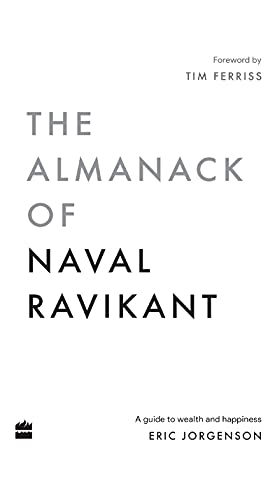
The Almanack of Naval Ravikant by Eric Jorgenson
Contents Link to heading
- Introduction (2 notes, 0 exercises)
- Building Wealth (71 notes, 9 exercises)
- Building Judgment (36 notes, 10 exercises)
- Learning Happiness (38 notes, 11 exercises)
- Saving Yourself (39 notes, 7 exercises)
- Philosophy (7 notes, 3 exercises)
Introduction Link to heading
2 highlights
Notes Link to heading
If you have nothing in your life, but you have at least one person that loves you unconditionally, it'll do wonders for your self- esteem.
Books make for great friends, because the best thinkers of the last few thousand years tell you their nuggets of wisdom.
Building Wealth Link to heading
71 highlights
Notes Link to heading
Making money is not a thing you do -- it's a skill you learn.
Getting rich is about knowing what to do, who to do it with, and when to do it. It is much more about understanding than purely hard work.
If you don't know yet what you should work on, the most important thing is to figure it out. You should not grind at a lot of hard work until you figure out what you should be working on.
Seek wealth, not money or status. Wealth is having assets that earn while you sleep. Money is how we transfer time and wealth. Status is your place in the social hierarchy.
Understand ethical wealth creation is possible. If you secretly despise wealth, it will elude you.
Ignore people playing status games. They gain status by attacking people playing wealth creation games.
You're not going to get rich renting out your time. You must own equity -- a piece of a business -- to gain your financial freedom.
Pick an industry where you can play long- term games with long- term people.
Play iterated games. All the returns in life, whether in wealth, relationships, or knowledge, come from compound interest.
Pick business partners with high intelligence, energy, and, above all, integrity.
Don't partner with cynics and pessimists. Their beliefs are self- fulfilling.
Learn to sell. Learn to build. If you can do both, you will be unstoppable.
Arm yourself with specific knowledge, accountability, and leverage.
Specific knowledge is knowledge you cannot be trained for. If society can train you, it can train someone else and replace you.
Specific knowledge is found by pursuing your genuine curiosity and passion rather than whatever is hot right now.
Building specific knowledge will feel like play to you but will look like work to others.
Embrace accountability, and take business risks under your own name. Society will reward you with responsibility, equity, and leverage.
Fortunes require leverage. Business leverage comes from capital, people, and products with no marginal cost of replication
Capital and labor are permissioned leverage. Everyone is chasing capital, but someone has to give it to you. Everyone is trying to lead, but someone has to follow you.
Leverage is a force multiplier for your judgment.
Reading is faster than listening. Doing is faster than watching.
Become the best in the world at what you do. Keep redefining what you do until this is true.
Specific knowledge cannot be taught, but it can be learned.
No one can compete with you on being you.
"Escape competition through authenticity."
Intentions don't matter. Actions do. That's why being ethical is hard.
When you find the right thing to do, when you find the right people to work with, invest deeply. Sticking with it for decades is really how you make the big returns in your relationships and in your money.
Embrace accountability and take business risks under your own name. Society will reward you with responsibility, equity, and leverage.
Clear accountability is important. Without accountability, you don't have incentives. Without accountability, you can't build credibility. But you take risks. You risk failure. You risk humiliation. You risk failure under your own name.
The people who have the ability to fail in public under their own names actually gain a lot of power.
people will forgive failures as long as you were honest and made a high- integrity effort.
If you don't own a piece of a business, you don't have a path towards financial freedom.
If it entertains you now but will bore you someday, it's a distraction. Keep looking.
The less you want something, the less you're thinking about it, the less you're obsessing over it, the more you're going to do it in a natural way. The more you're going to do it for yourself. You're going to do it in a way you're good at, and you're going to stick with it. The people around you will see the quality of your work is higher.
If they can train you to do it, then eventually they will train a computer to do it.
Forget rich versus poor, white- collar versus blue. It's now leveraged versus un- leveraged.
You're never going to get rich renting out your time.
Whenever you can in life, optimize for independence rather than pay. If you have independence and you're accountable on your output, as opposed to your input -- that's the dream.
Forget 10x programmers. 1,000x programmers really exist, we just don't fully acknowledge it. See @ID_AA_Carmack, @notch, Satoshi Nakamoto, etc.
What you want in life is to be in control of your time. You want to get into a leveraged job where you control your own time and you're tracked on the outputs.
If you want to be part of a great tech company, then you need to be able to SELL or BUILD. If you don't do either, learn.
Learn to sell, learn to build. If you can do both, you will be unstoppable.
Earn with your mind, not your time.
every human should aspire to being knowledgeable about certain things and being paid for our unique knowledge.
Value your time at an hourly rate, and ruthlessly spend to save time at that rate. You will never be worth more than you think you're worth.
No one is going to value you more than you value yourself. You just have to set a very high personal hourly rate and you have to stick to it.
money is not going to solve all of your problems, but it's going to solve all of your money problems. People realize that, so they want to make money.
Wealth creation is an evolutionarily recent positive- sum game. Status is an old zero- sum game. Those attacking wealth creation are often just seeking status.
"Do you want to leave your friends behind? Or be the one left behind?"
You have to say no to everything and free up your time so you can solve the important problems.
Retirement is when you stop sacrificing today for an imaginary tomorrow. When today is complete, in and of itself, you're retired.
How do you get there? Well, one way is to have so much money saved that your passive income (without you lifting a finger) covers your burn rate. A second is you just drive your burn rate down to zero -- you become a monk. A third is you're doing something you love. You enjoy it so much, it's not about the money. So there are multiple ways to retirement.
The way to get out of the competition trap is to be authentic, to find the thing you know how to do better than anybody.
Whether in commerce, science, or politics -- history remembers the artists.
Money is not the root of all evil; there's nothing evil about it. But the lust for money is bad.
I value freedom above everything else. All kinds of freedom: freedom to do what I want, freedom from things I don't want to do, freedom from my own emotions or things that may disturb my peace. For me, freedom is my number one value.
To get rich without getting lucky, we want to be deterministic. We don't want to leave it to chance.
Ways to get lucky: Hope luck finds you. Hustle until you stumble into it. Prepare the mind and be sensitive to chances others miss. Become the best at what you do. Refine what you do until this is true. Opportunity will seek you out. Luck becomes your destiny.
build your character in a certain way, then your character becomes your destiny.
One of the things I think is important to make money is having a reputation that makes people do deals through you.
Your character and your reputation are things you can build, which will let you take advantage of opportunities other people may characterize as lucky, but you know it wasn't luck.
"Be a maker who makes something interesting people want. Show your craft, practice your craft, and the right people will eventually find you."
You cannot hide anything from yourself. Your own failures are written within your psyche, and they are obvious to you. If you have too many of these moral shortcomings, you will not respect yourself.
The worst outcome in this world is not having self- esteem. If you don't love yourself, who will?
"The closer you want to get to me, the better your values have to be."
Apply specific knowledge with leverage and eventually, you will get what you deserve.
People are oddly consistent. Karma is just you, repeating your patterns, virtues, and flaws until you finally get what you deserve. Always pay it forward. And don't keep count.
anything you're given doesn't matter. You have your four limbs, your brain, your head, your skin -- that's all for granted. You have to do hard things anyway to create your own meaning in life. Making money is a fine thing to choose. Go struggle. It is hard. I'm not going to say it's easy. It's really hard, but the tools are all available. It's all out there.
Money buys you freedom in the material world. It's not going to make you happy, it's not going to solve your health problems, it's not going to make your family great, it's not going to make you fit, it's not going to make you calm. But it will solve a lot of external problems. It's a reasonable step to go ahead and make money.
solution to making everybody happy is to give them what they want.
Amazing how many people confuse wealth and wisdom.
Exercises Link to heading
1. Understand Wealth Creation Link to heading
Story: Naval opens the book with a fundamental reframe: "Making money is not a thing you do -- it's a skill you learn." He argues that society pays you for creating value -- for delivering what it wants but doesn't yet know how to produce at scale. The people who get rich aren't the ones who chase money; they're the ones who solve real problems. This shifts the question from "How do I make money?" to "What valuable thing can I create?" It democratizes wealth creation: anyone who learns to provide value can participate. Why This Works: This exercise flips the mental model from scarcity (chasing money) to abundance (creating value). Most people never pause to ask what society actually needs. By identifying unmet needs, you align your efforts with market demand instead of working against it.
How to execute:
- Start by observing your daily life for one week. What frustrates you? What do you wish existed? Talk to friends and colleagues about their pain points. Write down every problem you notice, no matter how small. At the end of the week, pick the three most common or intense problems. Next, assess your own skills honestly -- where do you already have an unfair advantage? The intersection of a real need and your unique ability is your wealth creation zone. Commit to exploring one of those intersections for 30 days. Don't worry about having a complete plan; just start exploring. Watch Out For: Don't fall into the trap of thinking you need a revolutionary idea. Most wealth is built on small, incremental improvements to existing solutions. Also avoid paralysis from too many options -- pick one intersection and start, even if it's not perfect.
2. Find Specific Knowledge Link to heading
Story: Naval introduces "specific knowledge" as the foundation of wealth. It's the unique expertise that can't be trained for -- only discovered through genuine curiosity. What felt like play to you as a teenager probably looked like work to others. That's your specific knowledge: the thing you do effortlessly that others find difficult. You can't decide what it will be; you can only uncover it by following what fascinates you. Why This Works: This exercise cuts through "find your passion" platitudes by giving you a concrete diagnostic: what looked like play versus work. It's liberating because it removes pressure -- you don't create specific knowledge, you discover it.
How to execute:
- Take 30 minutes in a quiet space. Think back to your childhood and teenage years. What hobbies did you lose yourself in? What subjects could you read about for hours? What did friends come to you for help with? Write down everything without filtering. Look for patterns -- if you loved organizing as a kid and still love systems now, that's a signal. Ask three people who know you well: "What do you think I'm naturally good at?" Their answers will surprise you. Finally, write a one-sentence description of your specific knowledge and test it against your real work. Watch Out For: The biggest trap is dismissing your natural abilities because they seem "too easy." They don't feel easy to everyone. Specific knowledge often emerges from the intersection of multiple skills, not a single talent. Don't expect one label.
3. Build Specific Knowledge Daily Link to heading
Story: Naval built his reputation not through aggressive self-promotion, but by sharing his genuine curiosity on Twitter for years. He didn't chase trends. He simply explored what fascinated him and wrote about it publicly. Over time, this authentic expression attracted an audience and opened doors. The key was consistency driven by genuine interest, not discipline or strategy. This is specific knowledge in action: following curiosity until it compounds into expertise. Why This Works: This exercise breaks the myth that you need a formal strategy to build expertise. Pure curiosity sustained over time naturally produces rare and valuable knowledge. The "no goal" instruction removes the performance anxiety that kills genuine exploration.
How to execute:
- Clear 30 minutes today with no agenda. Pick a topic you're genuinely curious about -- anything from medieval history to how engines work to why birds migrate. No career relevance required. Read one article, watch one video, or listen to one podcast on that topic. Don't take notes. Don't try to apply it. Just follow the thread of your curiosity. If something sparks more interest, follow that. Tomorrow, do the same thing. The goal is not mastery but the habit of following curiosity. After one week, look back and notice what pulled you most strongly. Watch Out For: Your inner critic will say this is unproductive. Ignore it. The most valuable knowledge often looks useless at first. Avoid the urge to optimize -- if you catch yourself strategizing about which topic is "best," return to what's most interesting right now.
4. Play Long-Term Games Link to heading
Story: Naval observes that all significant returns in life come from compound interest -- not just in money, but in relationships, knowledge, reputation, and health. The people who win big are the ones who make time their ally. "Play long-term games with long-term people" is his core principle. Short-term thinking leads to short-term results, while long-term thinking unlocks exponential growth. Most people dramatically underestimate the power of small, consistent actions over years. Why This Works: This exercise forces you to confront the gap between your stated time horizon and your actual behavior. Most people claim to think long-term but operate on daily or weekly cycles. Identifying a short-term game creates immediate awareness.
How to execute:
- Audit your current activities across career, relationships, and personal growth. For each, ask: "What's my implicit time horizon here?" Be honest. If you spend 40 hours a week on a job you see as a stepping stone, note it. For each short-term game, imagine the 10-year version. Would you invest differently in that skill? Would you approach that relationship with more patience? Write the long-term approach. Pick one area to shift from short-term to long-term starting today. Commit to one small action that reflects the longer horizon. Watch Out For: Short-term thinking is often rational -- bills need paying, deadlines need meeting. The goal isn't to quit everything short-term but to recognize when you're sacrificing the long game. Also, patience without action is just waiting.
5. Pick Long-Term People Link to heading
Story: Naval adds a crucial nuance: long-term games require long-term people. Some people are transactional -- they take what they can and move on. Others are compounders -- they build relationships that grow in value over decades. The people you surround yourself with determine the quality of your thinking, opportunities, and resilience. Trust, reputation, and mutual commitment become more valuable with time, but only if both parties are playing the same game. Why This Works: This exercise surfaces the hidden quality of your professional network. Most people never evaluate whether their relationships are compounding or decaying. The act of listing and rating your contacts makes invisible dynamics visible.
How to execute:
- Open your contacts or LinkedIn. List the five people you interact with most frequently professionally. For each, ask: "Is this relationship growing in trust, depth, and mutual benefit?" Rate each as "compounding," "flat," or "decaying." Notice patterns. Are your compounding relationships with people who share your values and time horizon? Identify one person you'd like to add to your network -- someone you admire who plays long-term games. Take one small step toward building that connection: share something valuable, ask a thoughtful question, offer help. Watch Out For: Avoid the trap of transactional networking -- collecting contacts without depth. A long-term relationship isn't about what you can get but what you can build together. Also don't rush to cut people off; some relationships go through flat periods before compounding again.
6. Take Accountability Link to heading
Story: Naval emphasizes that accountability is one of the highest-leverage traits you can develop. Most people avoid putting their name on things because it creates risk. But that very avoidance is why accountability is richly rewarded. When you stake your reputation on an outcome, you signal confidence and commitment. The market rewards this disproportionately because accountable people are rare. Naval points out that true accountability requires ownership and skin in the game. Why This Works: This exercise cuts through the comfort of anonymity. Most people hide in collective responsibility or vague promises. The prompt to "claim it today" creates urgency and breaks the cycle of avoidance.
How to execute:
- Think about your current work and life. Where are you hedging? Where have you been saying "we" when you could say "I"? List three areas where you've been avoiding full ownership. For each, ask: "What's the worst that happens if I own this and fail?" Then ask: "What's the best that happens if I own this and succeed?" Pick ONE thing you've been avoiding. Today, make a public commitment -- send an email, have a conversation, announce it to someone. Notice how the energy shifts once you're committed. Watch Out For: Accountability without leverage or ownership can mean more work for the same reward. Ensure you're being rewarded for the risk you're taking. Also, don't confuse accountability with control -- you can be accountable without controlling every variable.
7. Build Equity Link to heading
Story: Naval's famous line: "You're not going to get rich renting out your time. You need equity." Time is finite -- you have 24 hours a day, and trading them for money caps your earning potential. Equity is a claim on future value that can grow without your direct time input. Even a small percentage of a growing enterprise can be worth far more than a high salary. Ownership is the only path to true financial independence because it decouples income from hours. Why This Works: This exercise challenges the default assumption that a good salary equals financial success. Most people optimize for higher pay without ever asking whether they're building ownership. It creates a critical fork: stay on the time-for-money treadmill or start working toward equity.
How to execute:
- Assess your current income sources. What percentage comes from your time (salary, hourly work)? What percentage comes from ownership (business equity, investments, royalties)? If ownership is zero, identify one concrete step toward building it this week. Options: negotiate equity in your current role, start a side project, invest in appreciating assets, or create intellectual property (a course, book, software). Pick ONE and take the smallest possible step: a conversation, a first line of code, a domain registration. The goal is not immediate equity but the trajectory toward it. Watch Out For: Equity can be worthless if the underlying asset never grows. Dilution, bad terms, and illiquid markets can turn paper wealth into nothing. Don't confuse owning equity with being wealthy -- the value must be real.
8. Find Leverage Link to heading
Story: Naval identifies three types of leverage: labor (others working for you), capital (money generating money), and the new leverage of code and media. The first two require permission. The third requires no one's permission. Code and media are "permissionless leverage": create once, benefit forever while you sleep. This fundamentally changes wealth creation by letting anyone with a laptop and creativity produce value at scale. The internet has made permissionless leverage available to billions. Why This Works: This exercise shifts focus from "working harder" to "working once, benefiting forever." It directly addresses trading time for money by showing a concrete alternative. The question "What could you create once?" is simple but profound.
How to execute:
- Think about your skills and knowledge. What could you create ONE TIME that would continue providing value? Options include: writing a guide, recording a course, building a small software tool, creating a template, starting a niche newsletter. The format matters less than the principle: create once, distribute forever. Pick one idea and commit to a minimum viable version. Don't aim for perfect -- aim for done. If you're technical, build a simple tool you wish existed. If not, write a guide about something you know well. The internet distributes for free if the content is valuable. Watch Out For: Permissionless leverage still requires skill and taste. A bad product won't spread regardless of leverage. Also avoid the "create and abandon" trap -- the most successful leveraged assets require ongoing attention and improvement.
9. Get Paid for Judgment Link to heading
Story: Naval makes a crucial observation: in the age of leverage, the bottleneck becomes judgment. "In an age of infinite leverage, judgment becomes the most valuable skill." Judgment is the ability to make good decisions about deploying resources, time, and attention. It requires understanding second and third-order consequences. Unlike effort, judgment can't be automated or delegated easily. People with great judgment are rare and disproportionately rewarded. Why This Works: This exercise trains the muscle that matters most in a leveraged world. Thinking through consequences is a skill that compounds. Writing consequences externalizes thinking that usually stays vague, making it visible and testable.
How to execute:
- Identify a significant decision you're facing. Write it at the top of a page. Create three columns: "First-order consequences," "Second-order consequences," and "Third-order consequences." Fill them in honestly. For first-order, list immediate results. For second-order, ask: "What happens next as a result?" For third-order, go one level deeper. Example -- new job. First: more money, more stress. Second: bigger lifestyle, less family time. Third: kids grow up with absent parent. Compare options. The decision with the best third-order consequences is usually right, even if first-order looks worse. Watch Out For: Analysis paralysis is real. You don't need perfect predictions -- just think one or two levels deeper than usual. Also, be aware of emotional bias: we tend to invent rosy third-order consequences for what we already want.
Building Judgment Link to heading
36 highlights
Notes Link to heading
If you want to make the maximum amount of money possible, if you want to get rich over your life in a deterministically predictable way, stay on the bleeding edge of trends and study technology, design, and art -- become really good at something.
You don't get rich by spending your time to save money. You get rich by saving your time to make money.
wisdom is knowing the long- term consequences of your actions.
In an age of leverage, one correct decision can win everything.
Without hard work, you'll develop neither judgment nor leverage.
You have to put in the time, but the judgment is more important. The direction you're heading in matters more than how fast you move, especially with leverage.
"Clear thinker" is a better compliment than "smart."
if someone is using a lot of fancy words and a lot of big concepts, they probably don't know what they're talking about. I think the smartest people can explain things to a child. If you can't explain it to a child, then you don't know it.
The really smart thinkers are clear thinkers. They understand the basics at a very, very fundamental level.
The number one thing clouding us from being able to see reality is we have preconceived notions of the way it should be.
You can only make progress when you're starting with the truth.
The hard thing is seeing the truth. To see the truth, you have to get your ego out of the way because your ego doesn't want to face the truth. The smaller you can make your ego, the less conditioned you can make your reactions, the less desires you can have about the outcome you want, the easier it will be to see the reality.
The more desire I have for something to work out a certain way, the less likely I am to see the truth.
What you feel tells you nothing about the facts -- it merely tells you something about your estimate of the facts.
It's only after you're bored you have the great ideas. It's never going to be when you're stressed, or busy, running around or rushed. Make the time.
"Tension is who you think you should be. Relaxation is who you are."
You absolutely need habits to function. You cannot solve every problem in life as if it is the first time it's thrown at you. We accumulate all these habits. We put them in the bundle of identity, ego, ourselves, and then we get attached to them.
To be honest, speak without identity.
Facebook redesigns. Twitter redesigns. Personalities, careers, and teams also need redesigns. There are no permanent solutions in a dynamic system.
Radical honesty just means I want to be free. Part of being free means I can say what I think and think what I say. They're highly congruent and integrated.
If you have a criticism of someone, then don't criticize the person -- criticize the general approach or criticize the class of activities. If you have to praise somebody, then always try and find the person who is the best example of what you're praising and praise the person, specifically. Then people's egos and identities, which we all have, don't work against you. They work for you.
Charisma is the ability to project confidence and love at the same time. It's almost always possible to be honest and positive.
Decision- making is everything. In fact, someone who makes decisions right 80 percent of the time instead of 70 percent of the time will be valued and compensated in the market hundreds of times more.
The more you know, the less you diversify.
I think being successful is just about not making mistakes. It's not about having correct judgment. It's about avoiding incorrect judgments.
Ignore the noise. The market will decide.
If you have two choices to make, and they're relatively equal choices, take the path more difficult and more painful in the short term.
Reading science, math, and philosophy one hour per day will likely put you at the upper echelon of human success within seven years.
Reading a book isn't a race -- the better the book, the more slowly it should be absorbed.
Pointing out obvious exceptions implies either the target isn't smart or you aren't.
The number of books completed is a vanity metric. As you know more, you leave more books unfinished. Focus on new concepts with predictive power.
Put truth above social approval.
Study logic and math, because once you've mastered them, you won't fear any book.
When it comes to reading, make sure your foundation is very, very high quality.
To think clearly, understand the basics. If you're memorizing advanced concepts without being able to re- derive them as needed, you're lost.
The three big ones in life are wealth, health, and happiness. We pursue them in that order, but their importance is reverse.
Exercises Link to heading
10. Prioritize Relentlessly Link to heading
Story: Naval delivers a hard truth: your calendar reveals your actual priorities, not your intentions. Everyone says they value health, family, and growth, but most calendars tell a different story. The gap between what we say we value and where we spend time is a source of much dissatisfaction. Naval advocates for ruthless elimination of anything that doesn't serve your top priorities. This isn't time management; it's acknowledging that time is your most valuable non-renewable resource. Why This Works: This exercise creates direct confrontation between intention and reality. It's harder to lie to yourself when your calendar is the evidence. The simple act of deleting one thing and replacing it creates immediate momentum.
How to execute:
- Open your calendar or time log for this past week. Write down your top 3 priorities in life (not what they should be, but what they actually are based on where you spent time). Now identify one recurring commitment that doesn't serve those top 3 -- a meeting you don't need, a habit that wastes time, an obligation you've outgrown. Delete it. Cancel the meeting, say no, remove the app. Replace that slot with one activity that directly serves a top priority. Schedule it as recurring. The goal is not to overhaul your entire life but to practice the muscle of saying no to the good so you can say yes to the great. Watch Out For: The biggest danger is misidentifying your priorities. If you say "health is priority 1" but spend zero time on it, you're lying to yourself. Your actual priorities are revealed by your behavior, not your words.
11. Work That Feels Like Play Link to heading
Story: Naval describes his own career as play. Thinking, reading, writing, investing, podcasting -- these never felt like work, yet they produced enormous wealth and influence. He argues that when work is play, you never burn out and naturally persist longer than anyone else. The people who dominate fields aren't the most disciplined; they're the ones who would be doing that thing anyway. This is the ultimate competitive advantage: enjoying what others find tedious. Why This Works: The 1-10 rating system makes an abstract concept measurable. By tracking which activities feel like play, you build data about your natural affinities. This data is more reliable than intuition about what you "should" be doing.
How to execute:
- For the next seven days, rate every activity on a scale of 1-10. 1 = pure drudgery, 10 = feels like play. Be specific: rate individual tasks, not your whole workday. At the end of the week, look for patterns. Which activities consistently scored 8 or higher? Which scored 3 or below? Now brainstorm: how can you do more 8-10s and fewer 1-3s? Can you delegate, automate, or eliminate the low scorers? Can you reframe some activities to be more enjoyable? Commit to one change this week. Watch Out For: Not everything that feels like play is productive. Some enjoyable activities are just entertainment. The goal is to find work that has a high play component. Some tasks will never be play -- minimize them, don't expect to eliminate them.
12. How to Get Lucky Link to heading
Story: Naval introduces four levels of luck. First: blind luck -- randomness. Second: luck from hustle -- moving fast increases surface area for lucky events. Third: luck from spotting opportunities -- preparation lets you see what others miss. Fourth: luck that finds you because of who you are -- your reputation attracts opportunities. The goal is to build toward the fourth kind. When you're known for something specific, luck comes to you. Why This Works: This framework transforms luck from passive (hoping for good fortune) into active (building conditions for luck to find you). The focus on reputation is powerful because it's within your control.
How to execute:
- Audit your current luck profile. What kind of luck have you experienced recently? What's your unique reputation right now? What are you known for? If nothing specific, that's your starting point. Pick one area where you want luck to find you. Identify the platforms where your target audience gathers. Start sharing your genuine thoughts, insights, or work publicly. Do this consistently for 90 days. The goal is not to go viral but to become someone who is "known for X" so opportunities start seeking you out. Watch Out For: Building reputation takes time -- don't expect level 4 luck in a week. Also avoid trying to be known for too many things. A clear, specific reputation attracts more luck than a vague "smart person" label.
13. Be Patient Link to heading
Story: Naval emphasizes that compounding requires time. The most successful people and investments all had one thing in common: they didn't quit. People often give up right before the compound curve turns upward. The period between starting and seeing results is the "boring middle" -- effort goes in, nothing visible comes out. Most interpret this as failure and quit, while the few who understand compounding wait. Why This Works: This exercise attacks the most common reason for failure: premature abandonment. By asking "was it failing or was it the boring middle?" it reframes quitting from a rational decision to a potential mistake.
How to execute:
- Think of something significant you've considered giving up on -- a business, a skill, a relationship. Write down what you hoped would happen and by when. Ask: was that timeline realistic? Compare to how long similar things take others. Research: how long did successful people in that domain take? Reflect on what's actually happening: are you making progress (even invisible) or has the thing truly stopped working? Ask one trusted person for perspective. Decide: recommit with a longer timeline, or quit deliberately -- not from frustration, but from considered judgment. Watch Out For: Patience can become stubbornness. Not everything deserves persistence. The key question is whether you're learning and improving, not just how long you've been at it. Patience without action is just waiting.
14. Judgment Is Everything Link to heading
Story: Naval makes a quantitative case: "Someone who decides right 80% of the time dramatically outperforms someone at 70%." The difference between good and great judgment compounds dramatically over many decisions. Decision-making is the single highest-leverage skill you can develop because every decision affects everything downstream. Most people focus on execution, but executing a bad decision is worse than inaction. Time spent improving judgment is time with infinite returns. Why This Works: This exercise creates a dedicated space for reflective thinking, which most people never schedule. Writing down assumptions and testing them externalizes your thinking, making it visible and challengeable.
How to execute:
- Schedule 30 minutes this week with no distractions. Identify the most important decision you're facing. Write it clearly. Now list every assumption you're making -- about the situation, people, probable outcomes, your capabilities. Be exhaustive. For each, ask: "How would I test this?" Mark each as "verified," "uncertain," or "unexamined." For uncertain ones, identify one action to get more information. For unexamined ones, acknowledge them as blind spots. Finally: would someone with different incentives see this differently? What would they see that you don't? Watch Out For: The most dangerous assumptions are the ones you don't know you're making. Invite someone you trust to challenge your thinking before you decide. Avoid over-analyzing small decisions; save this process for genuinely consequential choices.
15. Think Clearly Link to heading
Story: Naval describes clear thinking as rare because it's constantly under attack. Ego makes us defend bad positions. Emotion colors our perception. Identity ties us to wrong beliefs. Social pressure pushes us toward consensus instead of truth. Naval says stripping away these layers is the work of clear thinking. It requires intellectual honesty even when uncomfortable. The result is seeing reality as it is, not as you wish it were. Why This Works: Arguing the opposite of a belief you hold is one of the most powerful techniques for breaking identity attachment. It forces you to see the other side's logic and exposes weaknesses in your own position. This is the foundation of intellectual humility.
How to execute:
- Pick a belief you hold strongly. Set a timer for 5 minutes. Argue the opposite position as convincingly as you can -- out loud. Don't build a straw man; build the strongest possible case for why you might be wrong. Use phrases like "My opponents might argue..." After the timer, write down: what new perspectives emerged? Any cracks in your reasoning? What would need to be true for the opposite to be correct? Repeat this monthly with a different strongly held belief. Watch Out For: This isn't about abandoning your beliefs. It's about holding them more lightly. If you feel threatened by the exercise, that's exactly why you need it. Avoid performing it superficially -- really try to convince yourself of the opposite.
16. Shed Identity Link to heading
Story: Naval warns against tying your identity to any opinion or label. When you become "the Bitcoin person" or "the Agile person," you blind yourself to conflicting information. Your ego defends the label instead of seeking truth. Naval advocates for intellectual flexibility: hold opinions lightly, update them freely, never let a label own you. The most dangerous phrase is "I'm the kind of person who..." Why This Works: This exercise attacks ego attachment directly. The discomfort you feel while setting aside your most cherished label reveals how strongly you're tied to it. Awareness of that attachment is the first step toward freedom from it.
How to execute:
- What label do you wear most proudly? "Startup founder." "Minimalist." "Republican." "Python developer." Pick one. For 24 hours, consciously don't use that label. Describe yourself with verbs instead of nouns: "I build companies" not "I'm a founder." Notice the discomfort when you want to reach for the label. Notice when others try to assign it. At the end of the day, journal about what came up. Did you feel less certain? More open? The goal is not to discard the identity permanently but to create space between you and it. Watch Out For: Don't use this to justify flip-flopping. Having convictions and being attached to labels are different things. Also, others may push you back into your label; the exercise is about your internal relationship with it. ### Part II: Happiness The Story: Why This Works: How to Execute: Watch Out For:
17. The Myth of Happiness as a Goal Link to heading
Story: Naval challenges the Western assumption that happiness is a goal to pursue. He argues that happiness is not a destination you arrive at but a state you cultivate in the present. The relentless pursuit of "when X, then I'll be happy" is itself the source of unhappiness. Peace comes from accepting the present moment rather than constantly reaching for a better one. Happiness is not about getting what you want; it's about wanting what you already have. Why This Works: This exercise breaks the most common happiness trap: conditional happiness. By searching for specific examples of peace in your day, you train your brain to notice what's already working. The journaling creates evidence against the narrative that happiness is always in the future.
How to execute:
- Set a timer for 10 minutes. Write about a specific moment in the last 24 hours when you felt completely at peace. Not excitement, not joy -- peace. It might have lasted 30 seconds. Describe the moment in detail: where you were, what you were doing, what was absent (no notifications, no demands, no worries). Now contrast that with a recent moment you felt unhappy. What was missing in that moment? Presence? Acceptance? Safety? Write down: what would it take to create one more moment of peace tomorrow? Schedule it. Watch Out For: Don't confuse peace with passivity. You can be at peace and still take action toward goals. The difference is that action comes from a place of fullness, not deficiency. Also, don't expect to feel peaceful all the time; the goal is more moments, not all moments.
18. Happiness Is a Default State, Not a Goal Link to heading
Story: Naval takes his premise further: the default state of humans who aren't suffering is actually happiness. Observe young children before they learn to worry. Their natural state is presence, curiosity, and contentment. The constant mental noise we add -- comparing, desiring, regretting, planning -- is what obscures this baseline. Returning to that default doesn't require adding more to your life; it requires subtracting the noise. "Happiness is what's left when you remove the things that make you unhappy." Why This Works: This exercise flips happiness from additive (do more, achieve more) to subtractive (remove the sources of dissatisfaction). It aligns with Naval's broader philosophy of simplicity. Naming the removeable sources of unhappiness gives you concrete targets.
How to execute:
- Think about your current life. What is ONE thing you could subtract that would increase your peace? It could be a news habit, a toxic relationship, a subscription, a commitment, a notification setting. Make a list of 5-10 candidates. For each, imagine life without it for 24 hours. Then for a week. Pick one and remove it for 7 days. Turn off notifications, unsubscribe, cancel, or say no. Observe: did you miss it? Did the absence create space for something better? Decide whether to make the removal permanent. Watch Out For: Subtraction can feel like loss even when it's good for you. Anticipate withdrawal symptoms from social media or news. Also, don't subtract everything at once -- that creates emptiness. Subtract one thing, feel the effect, then decide about the next.
19. Happiness Is an Internal Choice Link to heading
Story: Naval argues that while we can't control external events, we can absolutely control our internal response. This isn't toxic positivity -- it's acknowledging that between stimulus and response, there's a space, and in that space is our freedom. Many people give away this freedom by outsourcing their emotional state to circumstances. "Happiness is a choice" in the same way that a healthy diet is a choice: simple in concept, difficult in practice, requiring constant reinforcement. Why This Works: This exercise makes the abstract idea of "choosing happiness" concrete and behavioral. By catching yourself in the act of blaming circumstances, you build awareness of the choice point. The reframe is a practical tool, not a platitude.
How to execute:
- Spend one day as an observer of your own mind. Every time you feel frustrated, irritated, or upset, pause and complete this sentence mentally: "I'm feeling [emotion] because [person/situation] made me..." Then reframe: "I'm choosing to feel [emotion] because of how I'm interpreting [situation]." The distinction is subtle but critical. At the end of the day, review your journal. Notice patterns: what situations trigger external attributions most? Commit to catching yourself faster tomorrow. Watch Out For: This exercise is very difficult. You will forget. You will resist. That's normal. The goal is not perfect reframing but increased awareness. Also, don't use this to invalidate legitimate emotions. Feeling angry about injustice is appropriate -- the choice is how long you stay in the feeling.
Learning Happiness Link to heading
38 highlights
Notes Link to heading
Don't take yourself so seriously. You're just a monkey with a plan.
Maybe happiness is not something you inherit or even choose, but a highly personal skill that can be learned, like fitness or nutrition.
I believe happiness is really a default state. Happiness is there when you remove the sense of something missing in your life.
Happiness is the state when nothing is missing. When nothing is missing, your mind shuts down and stops running into the past or future to regret something or to plan something.
happiness is not about positive thoughts. It's not about negative thoughts. It's about the absence of desire, especially the absence of desire for external things. The fewer desires I can have, the more I can accept the current state of things, the less my mind is moving, because the mind really exists in motion toward the future or the past. The more present I am, the happier and more content I will be.
If you ever want to have peace in your life, you have to move beyond good and evil.
Nature has no concept of happiness or unhappiness. Nature follows unbroken mathematical laws and a chain of cause and effect from the Big Bang to now. Everything is perfect exactly the way it is. It is only in our particular minds we are unhappy or not happy, and things are perfect or imperfect because of what we desire.
Happiness is what's there when you remove the sense that something is missing in your life.
One can be very happy as long as one isn't too caught up in their own head.
We think of ourselves as fixed and the world as malleable, but it's really we who are malleable and the world is largely fixed.
Real happiness only comes as a side- effect of peace. Most of it is going to come from acceptance, not from changing your external environment.
A rational person can find peace by cultivating indifference to things outside of their control.
Happiness, love, and passion... aren't things you find -- they're choices you make.
We crave experiences that will make us be present, but the cravings themselves take us from the present moment.
Anticipation for our vices pulls us into the future. Eliminating vices makes it easier to be present.
What if this life is the paradise we were promised, and we're just squandering it?
A happy person isn't someone who's happy all the time. It's someone who effortlessly interprets events in such a way that they don't lose their innate peace.
Looking outside yourself for anything is the fundamental delusion.
The fundamental delusion: There is something out there that will make me happy and fulfilled forever.
Desire is a contract you make with yourself to be unhappy until you get what you want.
it's way more important to perfect your desires than to try to do something you don't 100 percent desire.
Happiness is being satisfied with what you have. Success comes from dissatisfaction. Choose.
peace is not a guarantee. It's always flowing. It's always changing. You want to learn the core skill set of flowing with life and accepting it in most cases.
You can get almost anything you want out of life, as long as it's one thing and you want it far more than anything else.
Peace is happiness at rest, and happiness is peace in motion. You can convert peace into happiness anytime you want. But peace is what you want most of the time. If you're a peaceful person, anything you do will be a happy activity.
I don't think life is that hard. I think we make it hard.
The enemy of peace of mind is expectations drilled into you by society and other people.
The reality is life is a single- player game. You're born alone. You're going to die alone. All of your interpretations are alone.
All your memories are alone. You're gone in three generations, and nobody cares. Before you showed up, nobody cared. It's all single player.
You can increase your happiness over time, and it starts with believing you can do it.
When working, surround yourself with people more successful than you. When playing, surround yourself with people happier than you.
Essentially, you have to go through your life replacing your thoughtless bad habits with good ones, making a commitment to be a happier person. At the end of the day, you are a combination of your habits and the people who you spend the most time with.
If you can't see yourself working with someone for life, don't work with them for a day.
The more secrets you have, the less happy you're going to be.
First, you know it. Then, you understand it. Then, you can explain it. Then, you can feel it. Finally, you are it.
Being peaceful comes from having your mind clear of thoughts. And a lot of clarity comes from being in the present moment. It's very hard to be in the present moment if you're thinking,
We don't always get what we want, but sometimes what is happening is for the best. The sooner you can accept it as a reality, the sooner you can adapt to it.
There is no legacy. There's nothing to leave. We're all going to be gone. Our children will be gone. Our works will be dust. Our civilizations will be dust. Our planet will be dust. Our solar system will be dust. In the grand scheme of things, the Universe has been around for ten billion years. It'll be around for another ten billion years.
Exercises Link to heading
20. Desire Is a Contract Link to heading
Story: Naval's most powerful reframe about desire: "A desire is a contract you make with yourself to be unhappy until you get what you want." This reframes every want as potential suffering. The bigger the desire, the longer the contract of unhappiness. Some desires are worth the price; most aren't. By examining each desire's cost in present happiness, you can consciously choose which contracts to sign. The happiest people have fewer and better-chosen desires. Why This Works: This exercise transforms desire from an impulse you must follow into a contract you can review before signing. Writing down desires and rating them creates distance from the intensity of wanting. You can inspect your desires rationally rather than being driven by them.
How to execute:
- Take 15 minutes with a notebook. Write down everything you currently desire: a promotion, a relationship, more money, a vacation, a new purchase, a body change. For each, rate the intensity (1-10). Now calculate: what is this desire costing you in present happiness? How much time do you spend thinking about it? How much dissatisfaction does it create with your current state? For each desire with a happiness cost greater than the value, ask: can I release this? It doesn't mean you can't pursue good things -- it means you pursue them from contentment, not deficiency. Watch Out For: Some desires are worth keeping. The exercise is not about eliminating all wanting but about conscious choosing. Also, be honest about suppressed desires -- ignoring a deep want creates its own unhappiness.
21. Desire Is the Root of All Suffering Link to heading
Story: Naval goes deeper into desire's darker side: the constant stream of wanting is what creates suffering. Attachment to outcomes, to possessions, to identity, to approval -- these are all forms of desire that guarantee periodic unhappiness. The Buddhist framing is deliberate: attachment to impermanent things creates inevitable pain because impermanent things change, break, or depart. The path to peace is reducing the number of things you're attached to. Why This Works: This is the deepest level of Naval's desire framework. It challenges the Western assumption that desire drives progress and success. The exercise forces you to examine the attachment behind every desire, making visible what's usually invisible.
How to execute:
- Pick one thing you're deeply attached to. It could be an outcome (this deal must close), a possession (my car), an identity (being seen as smart), or a person (my partner must behave a certain way). Spend 15 minutes writing about the attachment itself: what does it give you? Security? Status? Control? What would you lose without it? Now imagine letting it go -- not the thing itself, but the ATTACHMENT to it. Write about what peace might look like without the grasping. This is an internal exercise; you don't need to actually relinquish anything externally yet. Watch Out For: This is advanced emotional work. If it feels destabilizing, stop. Don't try to release deep attachments without support. The goal is not forced detachment but increased awareness of what you're attached to.
22. Success Does Not Lead to Happiness Link to heading
Story: Naval makes a counterintuitive case: the very qualities that drive extreme success -- dissatisfaction, ambition, the inability to rest -- are antithetical to happiness. Many highly successful people are deeply unhappy. The pursuit of success often destroys the capacity for contentment. He points out that lottery winners and non-winners have the same baseline happiness after a year. If success doesn't sustainably raise happiness, then postponing happiness for success is a losing strategy. Why This Works: This exercise is an essential reality check for anyone using the "work hard now, be happy later" justification. It creates a direct comparison that most people never make explicitly.
How to execute:
- Draw two columns. Left column: "Success (according to my culture/family/peers)." Right column: "Happiness (as I define it)." Be specific in each. Now examine: how many items overlap? The smaller the overlap, the bigger the gap you're living in. For successes you're currently pursuing that don't appear in your happiness list: WHY are you pursuing them? Be honest. Is it obligation? Fear? Social pressure? Now choose one non-overlapping success and deprioritize it this month. Redirect that energy toward a happiness item. Watch Out For: This exercise can be uncomfortable if you discover a large gap. Don't judge yourself -- awareness is the first step. Also, some success and happiness overlap is healthy; the goal is alignment, not renunciation.
23. Accepting Without Desiring Link to heading
Story: Naval describes the ideal state: doing pursuing improvement from a place of acceptance, not from a place of lack. You can want a better life while being fully content with your current one. Most people think these are contradictory because they've only experienced desire as deficiency. Acceptance without resignation is the balance: acknowledging reality as it is while still having preferences about the future. Why This Works: This is perhaps Naval's most nuanced and practical insight. It solves the apparent contradiction between ambition and contentment. By practicing it on small things, you build the muscle for big things.
How to execute:
- Pick a small frustration from today. Maybe it was traffic, a delayed email, or bad weather. Instead of fighting it mentally, practice: "I accept that this is happening. I would prefer it were different, but it's not. I'm okay." Say it out loud. Notice the shift in your body -- the relaxation around the resistance. Now apply this to a more significant challenge. Not resignation: still take action. But start from acceptance: "Given that this is my reality, what's the best next step?" Practice this reframe 5 times today. Watch Out For: The line between acceptance and resignation is blurry. A simple test: are you still taking constructive action? If yes, it's acceptance. If no, it might be resignation. Avoid using acceptance as an excuse for passivity.
24. Examine Your Reactions Link to heading
Story: Naval advocates for watching your own mind like a scientist. Every emotional reaction is data. Anger, jealousy, envy, frustration -- they all have something to teach you. But most people don't examine reactions; they're possessed by them. The space between trigger and response is where freedom lives. By examining reactions, you widen that space. Over time, you become less reactive and more responsive. Why This Works: This exercise builds the foundational skill of emotional self-awareness. Most people never pause to examine their reactions -- they just react. The "why did I react that way?" question is a lever into deeper self-understanding.
How to execute:
- The next time you feel a strong emotional reaction, do not suppress or act on it. Instead, pause for 5 seconds. Ask yourself: "Why did I react this way? What belief is being challenged?" If it's anger, what are you protecting? If jealousy, what do you want? Write down the trigger and the insight within 5 minutes. At the end of the week, review your reactions. What patterns emerge? Are certain people or situations predictable triggers? What would change if you were less reactive in those situations? Watch Out For: Don't over-analyze every minor irritation. Save this practice for genuinely strong reactions. Also, examining a reaction doesn't mean the reaction is wrong -- your anger at injustice is valid. The goal is understanding, not invalidation.
25. Peace Is the Path Link to heading
Story: Naval synthesizes his happiness philosophy: Peace is the goal in every moment. The most effective action comes from a place of peace, not agitation. When you're at peace, you make better decisions, treat people better, and see opportunities clearly. He describes happiness as a calm lake. When the lake is still, you can see the bottom clearly. When it's agitated by desires, fears, and distractions, you can see nothing. Why This Works: This exercise integrates the previous lessons into a single daily practice. The morning question sets an intention, and the evening review creates accountability. Over time, this builds peace as a muscle.
How to execute:
- Start tomorrow by asking: "What would be the most peaceful way to spend my day?" Not the most productive, not the most impressive -- the most peaceful. Then live the day with that question in the background. At each choice point, ask yourself: "Which option gives me more peace?" At the end of the day, review: when were you most at peace? Least? What could you have done differently? The point is not to transform your life overnight but to calibrate your compass toward peace. Repeat daily. Watch Out For: Peace doesn't mean avoiding hard work. Peaceful work still involves challenges -- you just approach them without anxiety and resistance. Avoid using this as a reason to procrastinate on hard but necessary tasks.
26. Happiness Through Non-Judgment Link to heading
Story: Naval observes that so much of our unhappiness comes from judging. We judge others -- which costs us nothing but creates internal agitation. We judge ourselves -- which erodes self-worth. We judge situations -- which adds resistance to reality. The alternative is to observe without evaluation. He describes this as the difference between seeing the world as a friend or enemy: non-judgment allows you to see things as they are, not as you evaluate them to be. Why This Works: This exercise trains non-judgment in the domain where it's most accessible: other people. Since you know their stories least, it's easier to suspend judgment. The practice then generalizes to yourself and situations.
How to execute:
- For one full day, whenever you catch yourself judging someone else, mentally replace the judgment with curiosity. Instead of "He's so rude," think "I wonder what's going on with him?" Instead of "She's incompetent," think "I wonder what her context is?" At the end of the day, notice how much lighter your mental load feels. Notice that you didn't lose anything by not judging. At the end of the week, try doing the same with yourself. When you make a mistake, instead of "I'm so stupid," try "Interesting. What can I learn from this?" Watch Out For: Non-judgment is not the same as approving of everything. You can disagree with someone's actions without judging them as a person. Also, don't beat yourself up for judging -- that's just more judgment.
27. Guided Meditation Link to heading
Story: Naval is a consistent advocate of meditation as the most practical tool for training the mind. He describes it as "sitting with yourself without distractions." The benefits are well-supported by research: reduced anxiety, improved focus, greater emotional regulation, and increased self-awareness. Yet most people know this and still don't meditate. The barrier is usually the expectation of doing it "right." There is no right. There's only showing up. Why This Works: This exercise removes all barriers to meditation by making it ridiculously easy: one minute, prompt available. Starting with one minute is the only way most people will actually do it. Consistency matters more than duration.
How to execute:
- Set a timer for 1 minute. Sit in a chair with your back straight. Close your eyes. Breathe normally. Count each breath: 1 on the inhale, 2 on the exhale, 3 on the next inhale... up to 10. When you reach 10, start again. When your mind wanders (and it will), gently return to counting. That's it. Do this once tomorrow. Then once the day after. After a week, try 2 minutes. After a month, 10 minutes. The goal is not a perfect practice but a consistent one. Use an app or just a timer. Naval suggests doing it first thing in the morning before checking your phone. Watch Out For: Your mind WILL wander. That's not failure; that's the practice. Every time you notice wandering and return, you're building the muscle. Avoid judging your meditation as "good" or "bad." Also avoid the trap of thinking longer is always better.
28. Body as the Foundation Link to heading
Story: Naval is emphatic that body and mind are not separate. Every mental state has a corresponding physical state. Anxiety lives in the chest. Anger lives in the shoulders. Peace lives in relaxed posture. "If you're unable to still the mind, still the body." This is the fastest path to emotional regulation. You can't think your way into calmness, but you can breathe your way there. The body is always available, always honest, and always responsive. Why This Works: This exercise gives you a tool that works even when your mind is racing. It's based on the physiological truth that the mind follows the body. By relaxing the body, you naturally calm the mind.
How to execute:
- Next time you feel stressed, pause. Don't try to change your thoughts. Instead, scan your body: Are your shoulders tense? Jaw clenched? Breathing shallow? One by one, release each area. Drop your shoulders. Unclench your jaw. Take three slow, deep breaths from your belly. Notice how your mind shifts within seconds. Now practice this proactively: set 3 alarms throughout the day as body check reminders. When they go off, take 10 seconds to scan and release. After a week, you'll start doing it automatically. Watch Out For: Do not use this to bypass genuine emotions that need attention. The goal is regulation, not suppression. Also, chronic tension may indicate deeper issues; body work is not a substitute for addressing root causes.
29. The Art of Solitude Link to heading
Story: Naval praises solitude as essential for happiness. He's not talking about loneliness but about the deliberate practice of time alone without stimulation. Most people fill every moment with input: podcasts, music, scrolling, talking. This leaves no space for the mind to settle. Solitude allows you to hear yourself, to process experiences, and to connect with what matters. It's the environment in which happiness grows naturally. Why This Works: This exercise counteracts the modern epidemic of constant stimulation by making one concrete change: leave the phone behind. The 30-minute walk becomes a conversation with yourself, which is where clarity emerges.
How to execute:
- Schedule 30 minutes this week with absolutely no input. No phone, no music, no podcast, no book, no conversation. You can walk, sit, stretch, or stare out a window. The first 5 minutes will feel uncomfortable. Your hand will reach for your phone. Stay with the discomfort. Let your mind wander. Notice what comes up: what thoughts have been waiting for silence? What feelings surface when there's nothing to distract you? Journal about the experience afterward. Repeat 3 times this week, then make it a habit. Watch Out For: This is harder than it sounds. Most people can't do 5 minutes. Start with whatever you can manage and build up. Also, solitude is different from disconnection. The goal is self-connection, not isolation from others.
30. Stop the Mental Chatter Link to heading
Story: Naval describes the inner monologue as the main source of human suffering. The nonstop narration -- judging, planning, regretting, worrying -- keeps us in a state of low-grade stress. He notes that much of this chatter serves no practical purpose. It doesn't improve decisions or prevent problems. It simply occupies space. The path to peace is turning down the volume of internal commentary. You don't need to narrate everything. Why This Works: This exercise makes the abstract concept of "mental chatter" concrete by asking you to observe and label it. Noticing the narrator creates distance from the narration. That distance is where peace begins.
How to execute:
- For one hour today, try to observe your inner monologue without engaging. Imagine you're in a movie theater and the voice is on the screen. Just watch and label: "There's the voice complaining." "There's the voice planning." "There's the voice judging." Don't try to stop it; just notice. At the end of the hour, reflect: how much of what the voice said was actually useful? How much was repetitive? Weren't you still functioning without engaging every thought? Practice this 1-hour observation window daily. Extend it over time. Watch Out For: This can feel disorienting at first. You might wonder: if I'm not my thoughts, who am I? That's a healthy existential question. If the practice becomes distressing, slow down. Also, don't try to silence the voice by force -- that creates more noise.
Saving Yourself Link to heading
39 highlights
Notes Link to heading
Doctors won't make you healthy. Nutritionists won't make you slim. Teachers won't make you smart. Gurus won't make you calm. Mentors won't make you rich. Trainers won't make you fit. Ultimately, you have to take responsibility. Save yourself.
No one in the world is going to beat you at being you. You're never going to be as good at being me as I am. I'm never going to be as good at being you as you are.
To make an original contribution, you have to be irrationally obsessed with something.
My number one priority in life, above my happiness, above my family, above my work, is my own health. It starts with my physical health. Second, it's my mental health. Third, it's my spiritual health. Then, it's my family's health. Then, it's my family's wellbeing. After that, I can go out and do whatever I need to do with the rest of the world.
We evolved for scarcity but live in abundance. There's a constant struggle to say no when your genes always want to say yes. Yes to sugar. Yes to staying in this relationship. Yes to alcohol. Yes to drugs. Yes, yes, yes. Our bodies don't know how to say no.
When everyone is sick, we no longer consider it a disease.
Outside of math, physics, and chemistry, there isn't much "settled science." We're still arguing over what the optimal diet is.
World's simplest diet: The more processed the food, the less one should consume.
The harder the workout, the easier the day.
Like everything in life, if you are willing to make the short- term sacrifice, you'll have the long- term benefit.
"Easy choices, hard life. Hard choices, easy life."
most of our suffering comes from avoidance.
If you stop talking to yourself for even ten minutes, if you stop obsessing over your own story, you'll realize we are really far up Maslow's hierarchy of needs, and life is pretty good.
Insight meditation lets you run your brain in debug mode until you realize you're just a subroutine in a larger program.
The ability to singularly focus is related to the ability to lose yourself and be present, happy, and (ironically) more effective.
The mind itself is a muscle -- it can be trained and conditioned. It has been haphazardly conditioned by society to be out of our control. If you look at your mind with awareness and intent (a 24/ 7 job you're working at every moment) I think you can unpack your own mind, your emotions, thoughts, and reactions. Then you can start reconfiguring. You can start rewriting this program to what you want.
Meditation is turning off society and listening to yourself.
The greatest superpower is the ability to change yourself.
Life is going to play out the way it's going to play out. There will be some good and some bad. Most of it is actually just up to your interpretation. You're born, you have a set of sensory experiences, and then you die. How you choose to interpret those experiences is up to you, and different people interpret them in different ways.
To have peace of mind, you have to have peace of body first.
You should always be internally ready for a complete change. Whenever we say we're going to try to do something or try to form a habit, we're wimping out.
When you really want to change, you just change. But most of us don't really want to change -- we don't want to go through the pain just yet. At least recognize it, be aware of it, and give yourself a smaller change you can actually carry out.
Impatience with actions, patience with results.
inspiration is perishable. When you have inspiration, act on it right then and there.
The current environment programs the brain, but the clever brain can choose its upcoming environment.
If there's something you want to do later, do it now. There is no "later."
The returns in life are being out of the herd.
For self- improvement without self- discipline, update your self- image.
Grind and sweat, toil and bleed, face the abyss. It's all part of becoming an overnight success.
Having the skill of persuasion is important because if you can influence your fellow human beings, you can get a lot done.
The hardest thing is not doing what you want -- it's knowing what you want.
My old definition was "freedom to." Freedom to do anything I want. Freedom to do whatever I feel like, whenever I feel like. Now, the freedom I'm looking for is internal freedom. It's "freedom from." Freedom from reaction. Freedom from feeling angry. Freedom from being sad. Freedom from being forced to do things. I'm looking for "freedom from," internally and externally, whereas before I was looking for "freedom to."
Courage isn't charging into a machine gun nest. Courage is not caring what other people think.
Value your time. It is all you have. It's more important than your money. It's more important than your friends. It is more important than anything. Your time is all you have. Do not waste your time.
Don't spend your time making other people happy. Other people being happy is their problem. It's not your problem. If you are happy, it makes other people happy. If you're happy, other people will ask you how you became happy and they might learn from it, but you are not responsible for making other people happy.
Anger is its own punishment. An angry person trying to push your head below water is drowning at the same time.
A taste of freedom can make you unemployable.
the mind should be a servant and a tool, not a master. My monkey mind should not control and drive me 24/ 7.
A busy mind accelerates the passage of subjective time.
Exercises Link to heading
31. Don't Take Yourself So Seriously Link to heading
Story: Naval uses humor as a spiritual tool. He points out the absurdity of humans taking themselves seriously: we're temporary beings on a speck of dust in an infinite universe, yet we get upset about traffic, you, and email. The ability to laugh at yourself is the ultimate antidote to ego. "If you can laugh at yourself, you've found the humor in your own suffering." This isn't nihilism; it's perspective. Why This Works: This exercise is about breaking the trance of self-importance. You're the main character in your life but a background character in everyone else's. Recognizing this is liberating.
How to execute:
- The next time you make a small mistake or embarrass yourself, pause. Instead of spiraling, imagine the situation from a cosmic perspective. Ask: "Will this matter in 100 years?" Then ask: "Is this actually funny?" Often it is. Practice: narrate your mistake like a sitcom scene. "And then I walked into the wrong meeting and sat through 15 minutes before realizing..." Bonus: Share the story and laugh at yourself with someone. Notice how laughing deflates the shame. Watch Out For: Don't use this to invalidate your own pain. Serious suffering exists. The exercise is for everyday indignities, not genuine tragedy. Also, don't become the person who never takes anything seriously.
32. Never Be the Most Miserable Person in the Room Link to heading
Story: Naval tells a story of a rule he lives by: never be the most miserable person in any room. This isn't about suppressing negative emotions or faking positivity. It's about recognizing that extreme misery is self-indulgent and serves no one. If you're suffering, you can still show up, be present for others, and not make your suffering the center of attention. The discipline of not being the most miserable is a gift to yourself and everyone around you. Why This Works: This exercise reframes misery as a choice -- not the feeling itself, but how you share it. It helps you recognize when your suffering has become performative or self-reinforcing. The outward focus breaks the loop of rumination.
How to execute:
- Consider a recent situation where you were struggling. Did you make it known? Did you play the "who has it worse" game? Did you decline to engage because of your mood? Now try the alternative next time. When you're struggling, ask: "Instead of broadcasting this, can I quietly carry it?" Show up. Ask others about their lives. Listen. If you need help, ask for it directly instead of leaking misery. Practice this: in your next social interaction, consciously not be the most miserable person there by focusing outward. Watch Out For: This is not about never showing vulnerability. Genuine vulnerability with trusted people is healthy. The rule is about not being perpetually the most miserable person in the room. Suppressing emotions to appear fine is also not the goal.
33. Relationships Are a Mirror Link to heading
Story: Naval notes that the people who frustrate you most are often mirroring something you dislike in yourself. The traits that trigger you are the ones you haven't accepted in your own psyche. This is uncomfortable but liberating: every difficult relationship is an opportunity for self-discovery. Your partner's messiness might reflect your own perfectionism. Your colleague's neediness might reflect your own fear of being dependent. Relationships reveal what needs healing. Why This Works: This exercise uses relationship friction as a diagnostic tool instead of just a source of frustration. By asking "where do I do this?" you turn external complaints into internal growth opportunities.
How to execute:
- Think of someone who consistently irritates you. Be specific: what exactly do they do that triggers you? Write it down. Now sit with the uncomfortable question: "Where do I do the same thing?" Look hard. Maybe not in the same context, but in some way. Your irritation at someone's disorganization might mirror your own messiness in a different domain. Your annoyance at their need for approval might reflect your own unacknowledged need. Write down the connection. Notice how the irritation shifts once you see yourself in them. Not completely, not always, but slightly. Watch Out For: This can feel like blaming yourself for being triggered by genuinely bad behavior. That's not the point. The point is that even with genuinely bad behavior, your emotional reaction is yours to understand. Some relationships are just toxic and need to end -- mirror exercise doesn't change that.
34. Your Partner Is a Mirror Link to heading
Story: Naval deepens the mirror concept specifically for romantic partnerships. Your partner triggers you because they're close enough to reflect the parts of yourself you've hidden. The person you choose is a reflection of your own psychology -- what you value, what you fear, what you need. A relationship is a continuous series of discoveries about yourself through interaction with another person. The most challenging relationships are usually the most transformative. Why This Works: This exercise makes the mirror concept deeply personal by focusing on the most significant relationship in most people's lives. The focus on "unhealed part of yourself" turns conflict into curriculum.
How to execute:
- Think of one recurring conflict with your partner. Write it down neutrally: "We fight about X." Now ask: "What unhealed part of myself does this conflict touch?" Examples: If you fight about money, do you have a scarcity wound from childhood? If you fight about time together, do you have an abandonment fear? Be honest. Write down what you discover. The goal is not to blame yourself or your partner but to see the conflict as co-created. Ask yourself: "If I healed this part of myself, would the conflict change?" Usually, the answer is yes. Watch Out For: This is not about accepting abusive behavior. The mirror concept applies to normal relationship friction, not to genuine mistreatment. Also, don't use this to bypass legitimate relationship issues that need communication, not just self-work.
35. Choose Your Partner Wisely Link to heading
Story: Naval is emphatic: your choice of life partner is the single most consequential decision you'll make. It affects your health, happiness, wealth, and children. A good partner multiplies your life; a bad partner divides it. He advises choosing someone who is fundamentally kind, intelligent, and has aligned values. Attraction matters, but character matters more. Most people spend more time choosing a restaurant than choosing a life partner. Why This Works: This exercise forces honest evaluation of a relationship that most people drift into without conscious assessment. The questions cut through romantic narratives to reveal the real dynamics.
How to execute:
- If you're in a relationship: sit down alone and answer these questions honestly. Does this person make me better? Do we have aligned values about money, family, and growth? Do we handle conflict constructively? Are we genuine friends? Rate 1-10 in each area. If any score is below 5, that's an area for honest conversation. If you're not in a relationship: write down the qualities that actually matter -- not the superficial ones, but the ones that predict a good partnership. Kindness. Emotional stability. Growth mindset. Shared values. Use this as your compass. Watch Out For: Don't evaluate your partner against an impossible ideal. Everyone has flaws. The question is whether the flaws are compatible with yours. Also, don't use this to make your partner feel evaluated. This is for YOUR clarity, not a weapon.
36. The Foundation of Every Great Relationship Link to heading
Story: Naval distills relationship success: the foundation is not chemistry, not communication skills, not shared interests -- it's commitment. The willingness to work through problems rather than walk away is what separates relationships that grow from ones that fade. When both parties are committed, problems become solvable. When commitment is conditional, every conflict becomes an existential threat. Why This Works: This exercise strips away the complexity of relationship advice and gets to the single factor that determines whether problems get solved or become dealbreakers. The question clarifies whether commitment is real.
How to execute:
- Think about your current or most recent significant relationship. Ask yourself honestly: "Am I committed to this relationship, or am I committed to my happiness, with this relationship being one possible source?" There's a big difference. True commitment means: "We will find a way through this challenge together." Conditional commitment means: "If this challenge becomes too hard, I leave." Mark which one you're practicing. If it's the second, that's not wrong -- but recognize it as risky territory. If you want the relationship to thrive, both parties need true commitment. Watch Out For: Commitment is not the same as staying in a harmful situation. True commitment includes boundaries. Also, commitment must be mutual for it to work. You can't commit your way into a good relationship if the other person hasn't.
37. Cancel the Cultural Defaults Link to heading
Story: Naval observes that so much of what we do comes from cultural defaults: go to school, get a job, buy a house, get married, have kids, work until 65, retire. Most people never examine whether these defaults actually serve them. The courage to question cultural scripts is the foundation of a deliberate life. Naval's own path -- dropping out, starting companies, making unconventional bets -- was a series of cancellations of what was expected. Why This Works: This exercise creates space between you and the cultural scripts you're running. Writing down what you're "supposed" to do makes the invisible visible. The question "would I choose this again?" is the most powerful filter for deliberate living.
How to execute:
- Take 20 minutes with a notebook. List everything you're "supposed" to do by society's standards. Include the big ones (marriage, career path, home ownership) and small ones (holiday obligations, social media presence, professional norms). For each item, ask: "If I were starting from zero today, would I choose this again?" Be honest. Some items will be immediate yeses -- keep those with gratitude. Others will be immediate nos. For the nos, ask: "What's keeping me in this default?" Identify one default to cancel this year. Not necessarily the biggest one. Just one. Watch Out For: Canceling defaults is disorienting. The people around you may resist your change. Anticipate this and proceed gently. Also, don't cancel something just because it's a default -- some defaults exist because they work.
Philosophy Link to heading
7 highlights
Notes Link to heading
The real truths are heresies. They cannot be spoken. Only discovered, whispered, and perhaps read.
Anyone around whom I can't be fully honest, I don't want to be around.
Before you can lie to another, you must first lie to yourself.
"To find a worthy mate, be worthy of a worthy mate."
Everyone starts out innocent. Everyone is corrupted. Wisdom is the discarding of vices and the return to virtue, by way of knowledge.
If wisdom could be imparted through words alone, we'd all be done here.
Inspiration is perishable -- act on it immediately.
Exercises Link to heading
38. The Enlightened Worker Link to heading
Story: Naval describes the ideal state of work: doing it because you genuinely want to, not because you need the money or status. The "enlightened worker" has achieved enough financial independence that work becomes optional. At this point, work transforms into pure creation. You only do work that you find meaningful, enjoyable, and aligned with your purpose. This shift in relationship to work is the ultimate freedom. Why This Works: This exercise bridges the wealth and happiness sections. It asks you to consider the purpose of wealth: not accumulation for its own sake, but the freedom to work on what matters. Starting now, not after retirement.
How to execute:
- Imagine you had enough money that you never had to work for pay again. Now answer: what would you do with your time? This is not a hypothetical -- this is Naval's definition of the enlightened worker. Write down what you'd do. Now circle the items you could start doing TODAY, even without financial independence. Most people find that some of their most meaningful activities are already accessible. Start doing one of those this week, alongside your regular work. The goal is not to quit your job but to begin orienting toward work that feels like purpose, not obligation. Watch Out For: Don't use this exercise to justify quitting your job impulsively. Financial independence takes time. The point is to start aligning your work with purpose even while building toward freedom. Also, don't pressure yourself to have a single grand purpose; small meaningful work counts.
39. The Meaning of Life Link to heading
Story: Naval offers a framework for understanding life's meaning on three levels. Level one: biological -- life is a process of replication and evolution. Level two: social -- life is about the stories we tell, the relationships we build, the impact we have. Level three: transcendent -- life is a mystery that we can't fully grasp. He suggests that the question "what is the meaning of life?" may be the wrong question. Perhaps the meaning is in the living itself -- in the experience of being conscious and present. Why This Works: This exercise doesn't ask you to find the answer but to explore the question. The very act of examining meaning is meaningful. The framework gives you a structure for thinking about a question that's easy to dismiss as unanswerable.
How to execute:
- Set aside 30 minutes in a quiet space. Write down your current relationship to meaning. Do you feel your life has purpose? If yes, what is it? If no, how does that feel? Now work through Naval's three levels: Level 1 (biological): what does your body and lineage mean to you? Level 2 (social): what impact do you want to have? Level 3 (transcendent): what mystery do you sense beyond understanding? Don't force conclusions. The act of thinking about these questions IS the exercise. End by writing one sentence: "For now, the meaning of my life is..." Allow it to change over time. Watch Out For: This can be an emotional exercise. It touches existential questions that carry a lot of weight. If it becomes overwhelming, that's normal. You're not supposed to have a definitive answer. The goal is engagement with the question, not a tidy conclusion.
40. Wealth + Happiness = A Life Well Lived Link to heading
Story: Naval concludes by integrating the two parts: wealth and happiness are not opposing forces. Wealth without happiness is empty. Happiness without resources can be fragile. The goal is not to choose one but to build both. Wealth provides freedom from financial anxiety. Happiness provides the capacity to enjoy that freedom. Together, they create the conditions for a life well lived. The journey is the destination. Why This Works: This capstone exercise forces integration of everything before it. By writing your own definition, you synthesize the two halves of the book into a personal philosophy. The one-sentence definition becomes a compass.
How to execute:
- Open a fresh page. Write at the top: "Wealth + Happiness = A Life Well Lived." Below, write your own definition of wealth (what does enough look like?), your own definition of happiness (what does peace look like?), and a one-sentence synthesis: "For me, a life well lived means..." Read what you've written. Does it align with how you're actually living? If there's a gap, identify one concrete action to close it. This action becomes your starting point. Naval's final message: the compounding effects of small, consistent actions -- in wealth, in happiness, in relationships -- are the only path to a remarkable life. Watch Out For: This is the end of the exercises but the beginning of the work. Don't try to implement everything at once. Pick the single most resonant exercise and commit to it for 30 days. That one change, compounded over time, will be more powerful than trying to change everything at once. --- Start tonight. Exercise 2: "What do I do effortlessly that others struggle with?"